NEW YORK (AP) – José Collado settled into a white table in a sunlit room, sang a few lines and injected heroin.
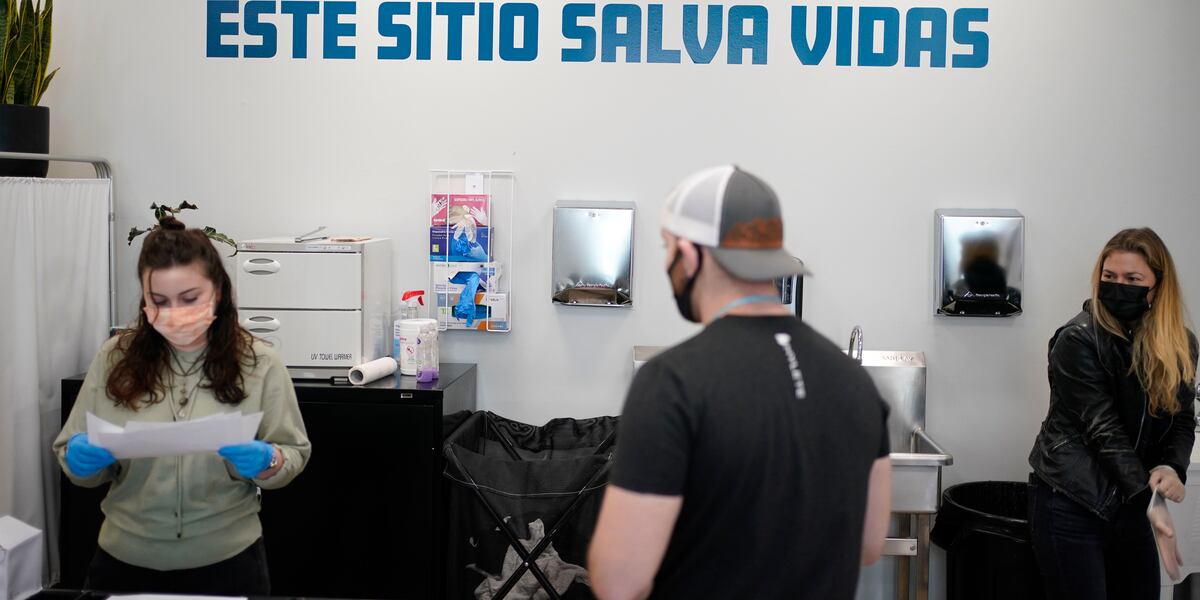
After years of shooting up on the streets and on rooftops, he was in one of the first two overdose-prevention centers operating in the United States, where authorities permit addicts to use drugs in safer conditions.
The centers are staffed with personnel and equipment capable of reversing overdoses. They represent a bold and contested response to the country’s opioid overdose death wave.
Supporters say it is a humane and realistic contribution amid the worst crisis related to drug use in the history of the United States. Critics argue that it is illegal and defeatist, ignoring the damage drugs do to users and communities.
For Collado, 53, the room he uses regularly is “a blessing.”
“They always look out for you, they take care of you,” he said.
“They make sure you won’t die,” his friend Steve Báez, 45, who has come close to death a couple of times, added.
In its first three months of operation in two neighborhoods with large Hispanic communities, East Harlem and Washington Heights, the program responded to more than 150 overdoses. It served about 800 people, who collectively made 9,500 visits. This year they will expand operations and run 24 hours a day.
“They offer a calm environment that people can use safely and stay alive,” says Sam Rivera, executive director of OnPoint NYC, the nonprofit that runs the centers. “We serve people whom many others consider disposable.”
Supervised drug-use centers are a novelty in the United States, but they have operated for decades in Europe, Australia and Canada. Several U.S. cities and the state of Rhode Island approved the idea, but none opened a center until New York did in November.
The announcement of the two centers’ opening came six weeks after the Supreme Court upheld a tribunal’s ruling that a center of this kind planned for Philadelphia was illegal, under a 1986 federal law that bans sites for illegal drug use.
The Department of Justice, however, indicated last month that it is likely to stop challenging these centers.
New York’s lone Republican representative, Nicole Malliotakis, promotes shutting down what she calls “heroine-consumption galleries that merely encourage drug use and degrade our quality of life.”
She proposes denying federal funds to any private, state or municipal entity that “operates or oversees” safe-injection centers.
Another New York representative, Democrat Carolyn Maloney, meanwhile, is pushing a plan for the state to fund these centers. Administrators say New York’s centers are currently financed by private donations, though with the support of groups that receive city and state funding to support their activities, including therapies and other services.
Several city and state officials support the centers. But in December, about a hundred people, including Democratic Rep. Adriano Espaillat, joined a demonstration to protest that the programs do not reach white, higher-income neighborhoods.
“The centers do God’s work, but they’re doing it in the wrong places,” said Shawn Hill, cofounder of a neighborhood group called the Greater Harlem Coalition.
People bring the drugs they will use, and the centers provide syringes, alcohol pads, inhalation straws and other items. And, most importantly, they also have oxygen and the drug naloxone to reverse overdoses.
The staff, including people who have used drugs, monitor for signs of overdoses and other needs, from advice on how to inject to more complicated matters.
Supporting a hand on the shoulder of a despondent, dispirited person, Adriano Feliciano urged him to talk to a therapist, and brought one to him during a recent afternoon.
“In many cases, offering a safe place is really just a kind of introduction to our services,” Feliciano, the center’s director of clinical and holistic services, said.
During a ten-day period in February, two people who frequented the centers died and a third fell into a coma after apparent overdoses at other places because the centers close at night, according to Kailin See, the programs director, who believes it is important to keep them open longer.
There have been no reports of deaths at supervised-injection centers in places where they are allowed, according to a 2021 report compiling several studies on the topic.
The report, from Boston’s Institute for Clinical and Economic Review, also found no link between safe-injection sites and crime rates, though drug use declined in some places.
“If you believe in harm reduction policies, here is a way to reduce harm that saves you money on ambulance rides,” said Dr. David Rind, the center’s medical director.
For Jim Crotty, a former Drug Enforcement Administration official under the Obama and Trump administrations, “the goal cannot be simply to save these people’s lives,” but rather to focus on treating addicts.
“If, like me, you believe drug use is highly destructive, the aim has to be for people to stop using drugs.”
OnPoint says its staff encourages, though not forces, conversations about treatment that many visitors have already tried.
“You have to be alive to try again,” See says.
Collado has tried several times to quit drugs. Like many addicts who frequent the centers, he lives on the street.
He and Báez lean on each other. They help each other work through situations, share the money they manage to get when one is in need, and try to ensure they don’t overdose and die alone.
“This is my home,” Collado says, referring to the addiction center. “This is my family.”
Copyright 2022 The Associated Press. All rights reserved.