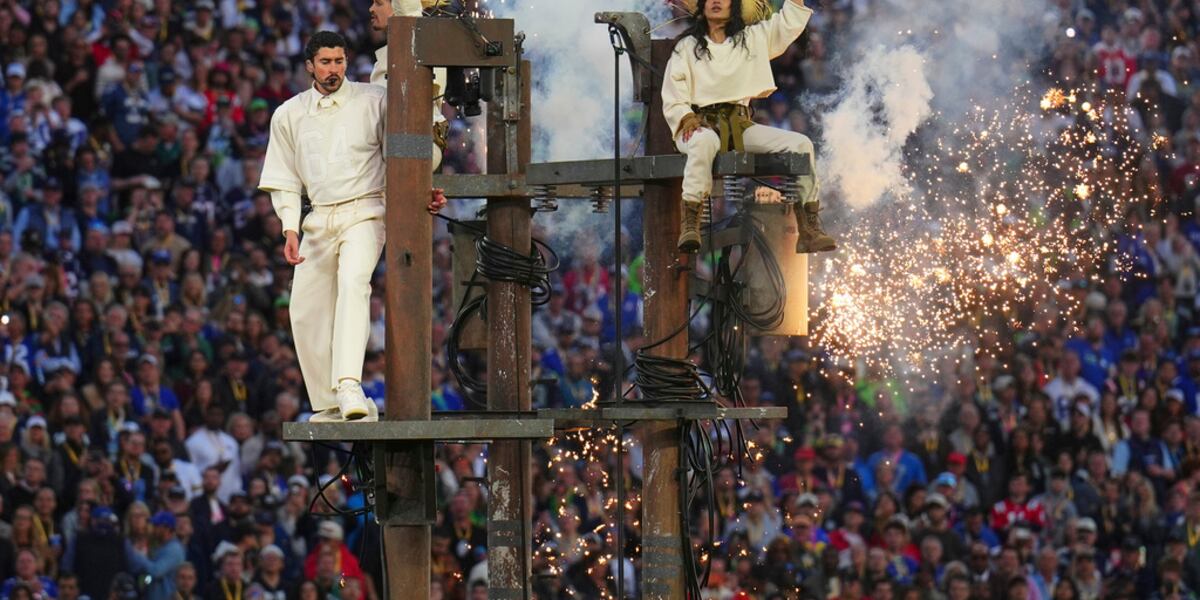
The sun hung low as Bad Bunny emerged from the sugar cane fields of Puerto Rico during his halftime show, surrounded by jíbaros wearing pavas (traditional straw hats), old men playing dominoes, and a piragua stand—shaved ice—undeniable symbols of Puerto Rico.
From a small Caribbean island with a complicated colonial history to the world stage: the artist, born Benito Antonio Martínez Ocasio, brought Puerto Rican culture to Levi’s Stadium in Santa Clara, California, for his Super Bowl 60 halftime show, a moment that from the outset promised to be historic for Latinos.
He opened with his big reggaeton hits, “Tití Me Preguntó” giving way to “Yo Perreo Sola,” as he reappeared atop the little house that stood as his Puerto Rican residence. Cardi B, Jessica Alba, Pedro Pascal, Karol G, Young Miko, Ronald Acuña Jr., Alix Earle, and Dave Grutman were invited to his marquee party, a house party vibe.
Then he punched through the roof of the house, briefly reviving “Gasolina” by Daddy Yankee, a clear shout-out to the Puerto Rican artists who helped pave the way for trap to go global.
“My name is Benito Antonio Martínez Ocasio,” he introduced himself to the crowd in Spanish. “And if I’m here today at Super Bowl 60, it’s because I never, ever stopped believing in myself, and you should believe in yourself too—you’re worth more than you think.”
The chords of his song “Monaco” rang out and then, a surprise: Lady Gaga stepped out at a wedding, singing her part of “Die with a Smile,” her collaboration with Bruno Mars, backed by a salsa band. Her dress featured a maga detail—the maga flower, Puerto Rico’s national blossom.
As they performed, the couple exchanged vows and Bad Bunny stood as a witness, signing the certificate.
He also found time for a wardrobe change, appearing in a white suit—classic for a salsa star—for “Baile Inolvidable” and “NuevaYol,” set against a neighborhood party stage where he toasted with Toñita, owner of one of the last Puerto Rican social clubs in New York City, the Caribbean Social Club in Brooklyn.
Ricky Martin, one of Puerto Rico’s greatest artists, performed “Lo Que Le Pasó a Hawaii,” a battle cry for Puerto Rican cultural autonomy amid a neo-colonial era. He sat in a plastic chair beside a banana tree; a scene drawn from the cover of Bad Bunny’s 2025 album “Debí tirar más fotos.”
Behind Martin, jíbaros with pavas climbed light poles that exploded, symbolic of Puerto Rico’s frequent blackouts and the faltering electricity grid. This gave way to an emotional rendition of “El apagón” from 2022, referencing Hurricane Maria, its aftermath, and the ongoing anger and frustration at chronic power outages.
Bad Bunny held a Puerto Rican flag in red, white, and light blue, a reflection of the Puerto Rican independence movement.
For about 13 minutes, in the Apple Music and Roc Nation–sponsored halftime show, all eyes on the field—and around the world—were on Benito.
Bad Bunny performed entirely in Spanish, since all his music is recorded in that language, though he has collaborated with English-speaking artists. The only English singing came from Gaga.
Although he did speak English at the show’s end when he said, “God Bless America,” and then named countries across the Americas: “Chile, Argentina, Uruguay, Paraguay, Bolivia, Peru, Ecuador, Brazil,” and so on, including the United States and Canada—a reminder that while “America” is often used as a stand-in for the United States, it really names an entire continent.
“And my homeland, Puerto Rico, we’re still here,” he said in Spanish.
Behind him, a screen read “The only thing more powerful than hate is love” in English, a direct nod to one of his recent Grammy speeches in 2026.
He closed with “DtMF” as he left the stadium, accompanied by musicians with güiros and tambourines.
For years, Bad Bunny has been one of the planet’s most-streamed artists. And on Sunday, he made clear that his global popularity translates effortlessly to America’s biggest stage. It wasn’t new to him, either. He had previously been a guest at the Super Bowl LIV halftime show in 2020 alongside Jennifer Lopez and Shakira. On that occasion, he sang in Spanish with two artists whose bilingual hits helped usher in an era when Latin music cracked US charts and beyond in the 2000s.
Consider the 2026 halftime performance the cherry on top of a watershed moment for the global superstar who, at 31, had spent only a decade earlier working in a supermarket in Puerto Rico.
Last week, he took home the Grammy for Album of the Year for Debí tirar más fotos, an album that fuses Puerto Rican folk traditions—bomba, plena, salsa, and jíbara music—with contemporary styles like reggaetón, trap, and pop. It marked the first time an album entirely in Spanish won the top prize.
As with most big-name halftime shows, details of Bad Bunny’s performance were kept under wraps in advance, though many speculated there would be some political moment. He has long been critical of President Donald Trump, and at the Grammys he said “ICE out” while accepting a televised award. His most recent tour also skipped the U.S. continental mainland; in an interview, he said the decision was partly due to fears that fans could be targeted by immigration agents.
In a Thursday press conference, Bad Bunny told Zane Lowe and Ebro Darden of Apple Music that audiences could expect a big party—and he joked that people didn’t need to learn Spanish to enjoy his set, but they should learn to dance.
“I want to bring to the stage, of course, a lot of my culture,” he said at the time. “I don’t want to give any spoilers. It’s going to be fun.”
And he delivered on that, with a message of hope and a reminder of Puerto Rico’s resilience.