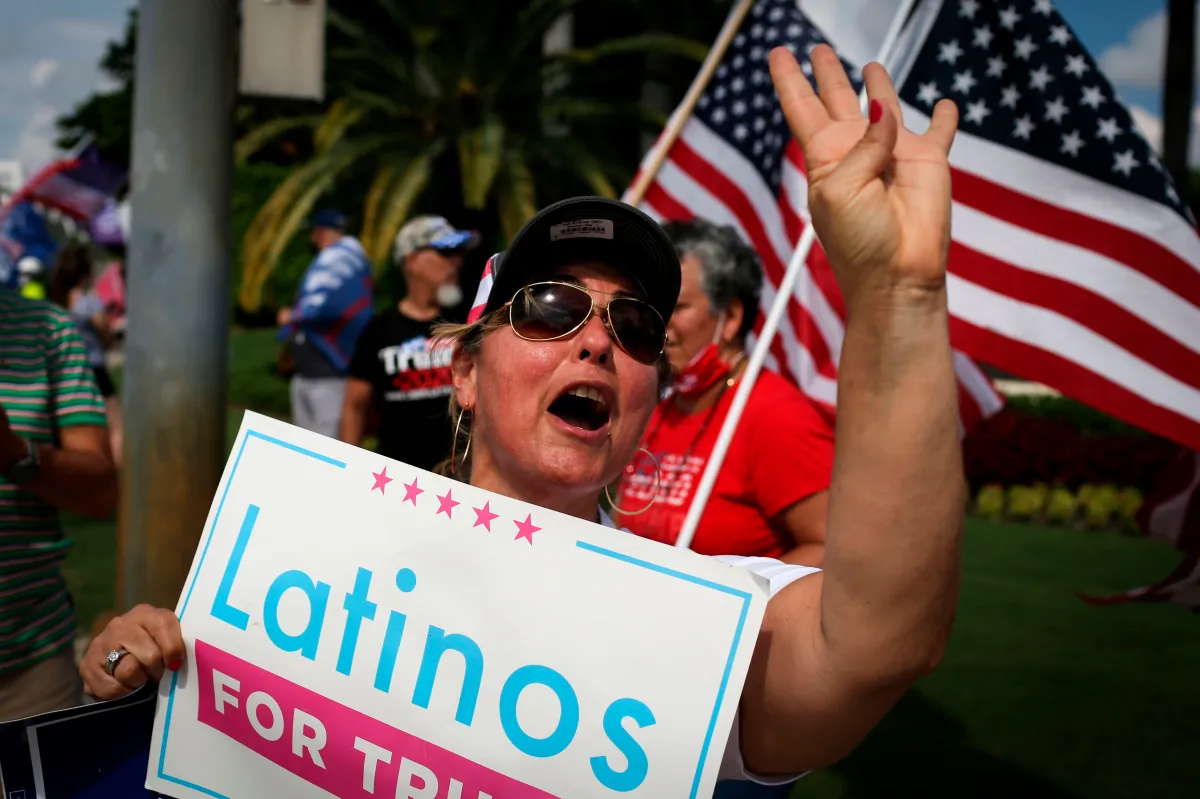
The impact of Donald Trump’s policies on the Latino community has been mixed, but it has left the poorest members behind.
Ryan Zamarripa, an analyst at the Center for American Progress (CAP), notes that Trump benefited from inheriting a country stabilized by Barack Obama following the 2008 crisis, which has allowed him to tout economic gains that he did not necessarily create.
“I think he was lucky and he’s taking credit for the hard work that Obama and (Joe) Biden did,” the expert said, highlighting that the Latino community had improved in the eight years prior to 2016, when Trump won the presidency.
Zamarripa stressed that the Republican is excellent at “selling himself,” and in this campaign he has paid more attention to the Latino community given the importance of their vote, attempting to reach it on economic issues, but in reality he has paid little heed to it: “To me it is a great disrespect that now he says he wants to help this community.”
There are four aspects Zamarripa highlights to see how Latinos fared under Trump’s policies.
1. Gap between Latinos and White Americans
The report indicates that in 2016, the typical white household had about $171,000 in wealth, including durable goods, while the typical Latino household had just over $20,000.
“In 2018, white taxpayers received nearly 80 percent of all the benefits from the Tax Cuts and Jobs Act (TCJA), while only 6.7 percent went to Latino taxpayers,” the CAP study states.
Based on data from a study by the Institute for Taxation and Economic Policy and Prosperity Now, it is known that the average tax cut for white households was twice as large as that for Latino households.
2. The child benefit gap
The analysis indicates that the TCJA doubled the Child Tax Credit (CTC) from $1,000 per child under 17 to $2,000.
“While the law significantly expanded eligibility for the credit to wealthier households, most low-income families with children received only partial or no benefit.” This resulted in a 50 percent shortfall for Latino children.
Another aspect highlighted is the exclusion of a large portion of the Latino workforce from the CTC, meaning those who report children with Individual Taxpayer Identification Numbers (ITIN) instead of Social Security Numbers (SSN).
“ITINs are used for tax filing by people who do not qualify for a Social Security number, including many undocumented workers who pay taxes, as well as other immigrant residents of the United States,” the experts note.
Thus, by denying the Child Tax Credit to low-income working families whose children have an ITIN, the law left out approximately one million children, most of them undocumented.
3. Benefit to White Americans
The Trump-backed law mainly benefits large corporations.
“Because it is far more likely that non-Hispanic White households own stock, both directly and through retirement accounts, these changes leave many Latino households with little to gain, while delivering a large, unexpected windfall to wealthy, predominantly White households,” the analysis states.
4. Wealth over work
The TCJA, the experts say, indicates that President Trump’s law significantly weakened the estate tax for the wealthiest individuals, who are predominantly White, helping to preserve dynastic wealth transfers across generations.
The TCJA provision expanded the estate tax exemption from $11 million to $22 million for married couples.
“This reduced the number of wealthy heirs who must pay and granted a tax cut of $4.5 million to each of the wealthiest estates,” they indicate. “The vast majority of this tax cut will go to rich White heirs.”
Experts cite the 2019 Survey of Consumer Finances, which shows that White families are far more likely to receive inheritances than Hispanic households.