THE HAGUE, Netherlands (AP) — A French woman and an American man tested positive for hantavirus on Monday as nations around the world rushed to repatriate people who had disembarked from a cruise affected by a deadly outbreak and place them in quarantine or isolation.
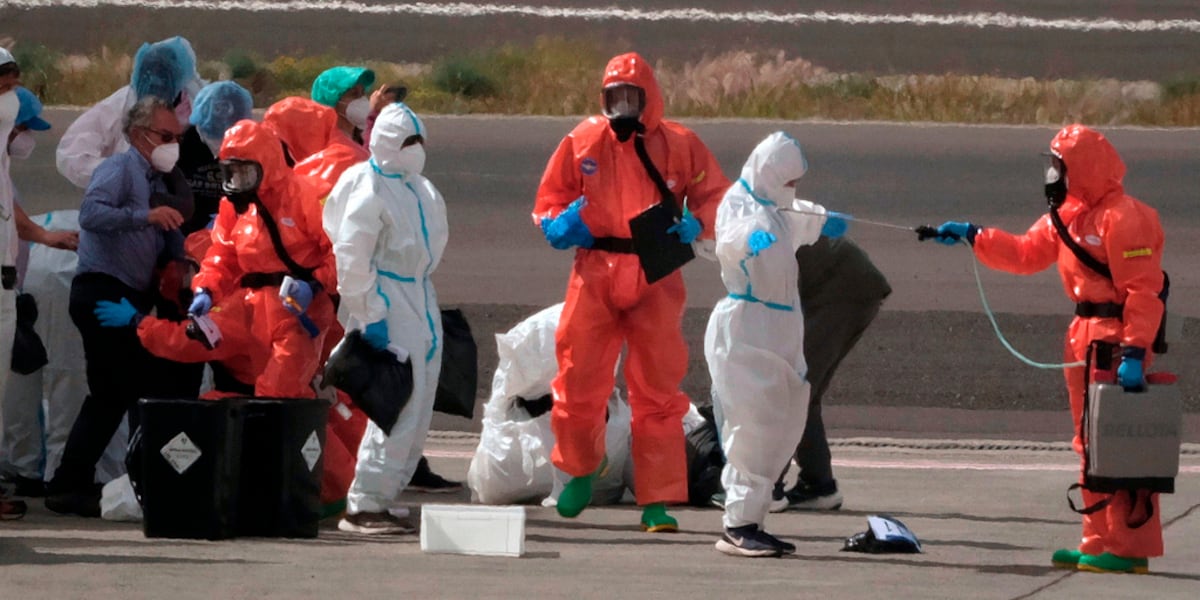
Passengers began flying back home on Sunday aboard military and government aircraft after the MV Hondius anchored off the Canary Islands. Personnel wearing full-body protective gear and respirators escorted travelers ashore in Tenerife in an operation that continued on Monday.
This is the first known outbreak of the unusual hantavirus on a cruise ship, according to Maria Van Kerkhove, the WHO’s director of outbreak and pandemic preparedness. So far three passengers have died on the ship, but health authorities continue to stress that the risk to the general population remains low.
The ship’s captain, Jan Dobrogowski, posted a video message on Monday praising passengers and crew for their perseverance and asking for privacy.
“I have witnessed their care, their unity and their quiet strength among everyone aboard — guests and crew alike — and I must commend my crew for the courage and selfless resolve they repeatedly showed in the toughest moments,” he said. “I could not imagine sailing in these circumstances with a better group of people, guests and crew alike.”
New Cases in France and the United States
A French woman evacuated from the cruise tested positive for hantavirus, and her condition worsened overnight at the hospital, French Health Minister Stephanie Rist said Monday. The woman was among five French passengers repatriated Sunday. Rist told the public broadcaster France Inter that she developed symptoms during the flight to Paris.
One of the 17 American passengers evacuated from the ship and flown to Nebraska also tested positive for hantavirus, but is asymptomatic, and another had mild symptoms, US health officials said late Sunday. The flight landed in the early hours of Monday, and the passengers were transported by waiting buses off the airport grounds.
The Americans would first be taken to the University of Nebraska Medical Center, which has a federally funded quarantine facility, to assess whether they have had close contact with anyone with symptoms and to gauge their risk of virus transmission.
“One passenger will be moved to the Nebraska Biocontainment Unit on arrival, while others will be taken to the National Quarantine Unit for evaluation and monitoring. The passenger bound for the Biocontainment Unit tested positive for the virus but is asymptomatic,” Kayla Thomas, a spokesperson for the Nebraska Medicine network helping care for the passengers, said.
The university medical center also houses a dedicated unit for treating people with highly infectious diseases, which was used at the outset of the pandemic for COVID-19 patients and previously for Ebola patients.
The World Health Organization recommended close monitoring of those who disembarked, and many countries have quarantined them.
Planes arriving in Tenerife were to remove passengers from more than 20 countries in an evacuation operation that was to wrap up on Monday.
A Dutch plane expected to reach Tenerife Monday afternoon would carry passengers who had previously been slated for evacuation on a plane sent by Australia, Spain’s Health Minister Mónica García said.
On Monday, 54 passengers and crew remained aboard the ship, of whom 22 were expected to disembark, while the remaining 32 would stay aboard as it returns to the Netherlands.
Three people have died since the outbreak began, and six people have been infected, WHO spokesperson Sarah Tyler said Monday. One person from the United States showed inconclusive lab results, she noted.
The Hondius left the southern Argentine port of Ushuaia on April 1, and a Dutch passenger died aboard on April 11. It wasn’t until early May that the World Health Organization said it was responding to a suspected hantavirus outbreak on the ship, which at that point was off the coast of the Cape Verde Islands in West Africa.
Health Officials Say the Risk to the Public Is Low
Hantavirus generally spreads through rodent droppings and does not easily transmit between people. But the Andes virus detected in the cruise outbreak could transmit between people in rare cases. Symptoms — including fever, chills and muscle pain — typically appear one to eight weeks after exposure.
WHO Director-General Tedros Adhanom Ghebreyesus said on Sunday that the general public should not worry about the outbreak. “This is not another COVID. And the risk to the public is low. So they should not be scared, and they should not panic.”
The WHO is advising origin countries of the passengers to maintain active surveillance and follow-up, meaning daily health checks, whether at home or in a dedicated facility, said Van Kerkhove, the organization’s top epidemiologist.
Numerous countries have said their citizens will be quarantined or hospitalized for observation.
Captain Dobrogowski said his thoughts “are with those who are no longer with us, and whatever I say will not ease this loss, but I want them to know that they are with us every day in our hearts and thoughts.”