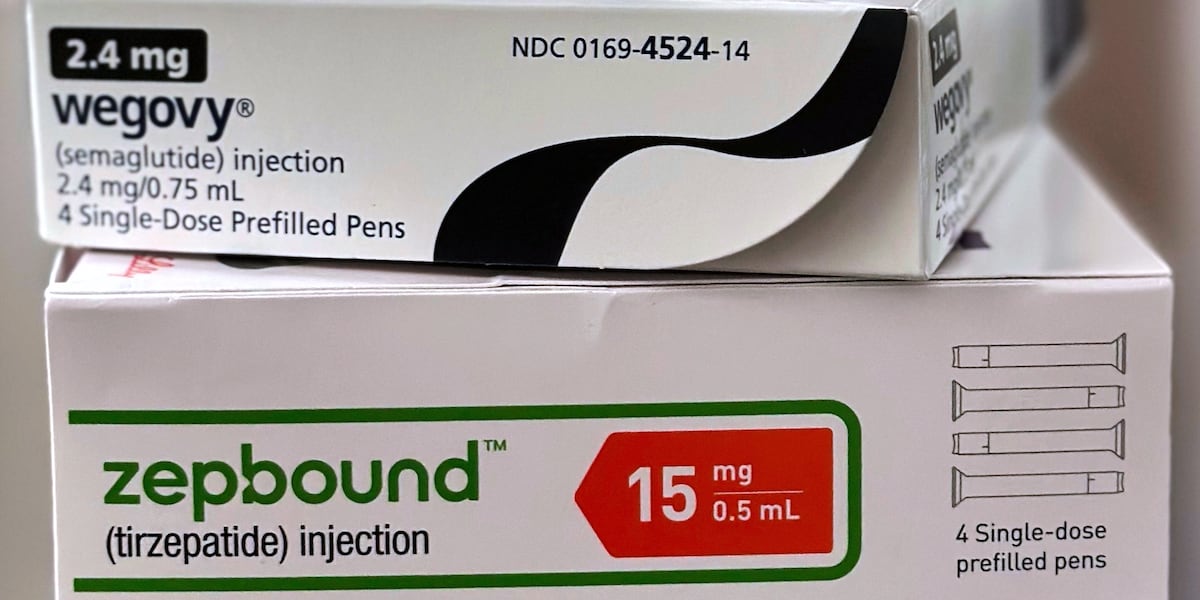
WASHINGTON, D.C. (AP) — President Donald Trump on Thursday announced an agreement with Eli Lilly and Novo Nordisk to broaden coverage and lower the prices of their popular obesity treatments, Zepbound and Wegovy.
Those medications are part of a new generation of obesity therapies known as GLP-1 receptor agonists, which have surged in popularity in recent years.
Yet access to them has remained a persistent challenge for patients due to their cost — roughly $500 a month for high doses — and uneven insurance coverage.
Coverage for obesity drugs will be expanded to Medicare beneficiaries starting next year, the administration said, and it noted that some lower prices will be phased in for people without coverage. Initial pill versions of newer formulations of the treatments will also cost $149 a month if approved.
“It will save lives, improve the health of millions and millions of Americans,” Trump said in a White House Oval Office announcement, referring to GLP-1 as a “weight‑loss drug.”
Thursday’s announcement marks the latest effort by the Trump administration to tackle rising prescription costs as part of its appeal to voters worried about the cost of living. Pfizer and AstraZeneca recently agreed to cut the costs of certain prescription therapies for Medicaid after an executive order issued in May set a deadline for voluntary price reductions or face new limits on what the government will pay.
As with previous deals, it remains unclear how much consumers will actually feel the price drop. Drug prices can vary depending on competition among therapies and the level of insurance coverage.
Obesity drugs have grown increasingly popular, but they’re costly
These obesity medications work by targeting hormones in the gut and brain that influence appetite and fullness. In clinical trials, they helped people lose between 15% and 22% of their body weight, equating to as much as 50 pounds (22.6 kilograms) or more in many cases.
Patients typically start on low doses and gradually escalate to higher amounts based on their needs. Because obesity is treated as a chronic disease, experts say, patients often need to stay on the medication indefinitely or risk regaining the weight.
The drugs’ rapid growth has been especially lucrative for Eli Lilly and Co. and Novo Nordisk. Lilly recently reported that Zepbound sales have tripled this year, surpassing $9 billion.
But for many Americans, the price tag has made them inaccessible.
Medicare, the federally funded program primarily serving people 65 and older, has not covered obesity therapies. In November, Trump’s predecessor Joe Biden proposed a rule that would have changed that. The Trump administration rolled it back in the spring.
Only a handful of Medicaid programs for low‑income individuals, funded jointly by states and the federal government, offer coverage. And employers and commercial insurers have been reluctant to pay for these drugs, in part because of the potential number of people who could use them.
The $500-a-month price for the higher doses also makes them unaffordable for the uninsured, doctors say.
Currently, Medicare covers the cost of drugs for conditions like type 2 diabetes and cardiovascular diseases, but not weight loss on its own.
Trump wants to show he’s attuned to cost‑of‑living concerns
The push to reduce cost barriers for the popular GLP‑1 drugs comes as the White House seeks to demonstrate that Trump understands Americans’ frustrations with rising prices for food, housing, healthcare, and other essentials.
Republican gubernatorial candidates in New Jersey and Virginia faltered in Tuesday’s elections, where voters’ bleaker views of the economy appeared to shape contests.
Nearly half of Virginia voters cited “the economy” as the top issue, and about six in ten of those voters chose Democrat Abigail Spanberger to win the governorship, delivering a decisive victory, according to an AP voter survey.
In New Jersey, Democrat Mikie Sherrill persuaded roughly two-thirds of voters, who said “the economy” is the state’s main problem, according to the survey. Sherrill defeated a Trump‑backed Republican, Jack Ciattarelli. More than half of New York City voters said the cost of living is the city’s primary issue, and the elected mayor, Democrat Zohran Mamdani, won about two‑thirds of that group.
The White House sought to dismiss the earlier Democratic administration’s efforts as a windfall for the pharmaceutical industry because the proposal did not include adequate price concessions from drugmakers.
Trump, by contrast, sealed a belt‑and‑suspenders deal ensuring Americans aren’t footing the bill for pharmaceutical innovation, said a senior administration official who spoke to reporters ahead of Thursday’s Oval Office announcement.
Another senior official said coverage for the drugs would be expanded to Medicare patients next year. Those who qualify will pay copays of $50 per medication.
Price reductions will also be phased in for those without coverage through the administration’s TrumpRx program, which will let people buy medicines directly from manufacturers starting in January.
Officials told reporters on a background basis, per White House rules, that lower prices would also apply to Medicaid programs funded by states and the federal government. And initial pill versions of the obesity treatments will cost $149 per month if approved.
The officials spoke on condition of anonymity.
Doctors applaud the price reductions
Dr. Leslie Golden has roughly 600 patients on one of these therapies, and 75% or more struggle to pay for them. Even with coverage, some face $150 copays to refill.
“At every visit they ask, ‘How long can we keep this going? What’s the plan if I can’t afford to continue?’” said Golden, an obesity medicine specialist in Watertown, Wisconsin. “Some of them have more than one job or have delayed retirement to keep paying.”
Lilly and Novo have already cut the prices of their drugs. Lilly announced earlier this year that it would reduce the upfront cost of Zepbound to $349.
Dr. Angela Fitch, who also treats obesity patients, said she hopes a White House–pharmaceutical deal could be a first step toward making the therapies more affordable.
“We need a hero in obesity care,” said Fitch, founder and medical director of knownwell, a weight-loss and medical care company. “The community has faced relentless barriers to access GLP‑1 medications, and it’s ultimately come down to price, despite data backing their effectiveness.”