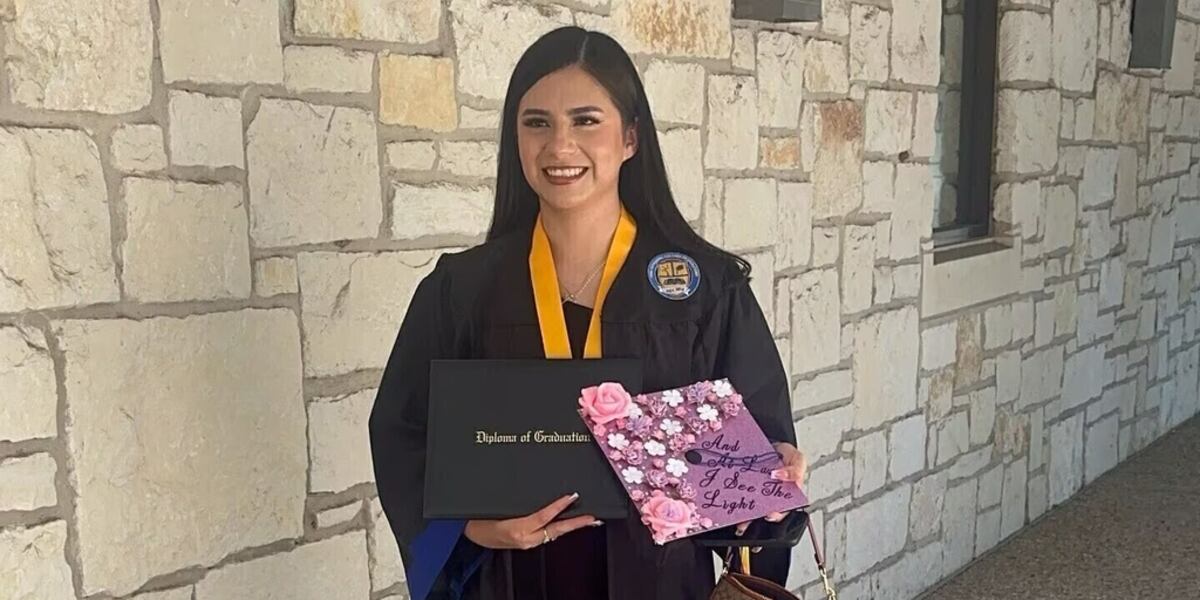
BOSTON (AP) — While traveling on a deportation flight bound for Texas, Any Lucía López Belloza kept asking herself why this was happening. She was a college student with no criminal record and no reason to believe she faced risk of being sent back to her homeland Honduras.
“It just hit me. I don’t know, like I froze,” López Belloza told The Associated Press on Friday in a phone interview from Honduras, where she is staying with her grandparents. A 19-year-old freshman at Babson College, she was detained at the Boston airport on November 20 as she prepared to fly home to Texas to surprise her family for Thanksgiving. She was deported two days later, and she returned to Honduras for the first time since she was eight years old.
Although the government has apologized for the fact that federal immigration authorities deported her by mistake — even after a Massachusetts judge ruled she should not be removed from the United States — her future remains uncertain. Her attorney on Friday asked a federal judge to order the Trump administration to develop a plan to bring her back into the country.
López Belloza and her mother were ordered deported several years after they arrived in the United States. Although the government says she missed several opportunities to appeal, López Belloza reported that her former attorney told her there was no deportation order. She insists she would never have tried to fly home in November had she known anything about it.
The hardest part of her sudden deportation has been not being able to spend Christmas with her parents, which at times has left her depressed and in tears. They worry about their mom and dad, who fear leaving their Texas home because, according to López Belloza, they have also been targeted by ICE, even though they applied for permanent residence, known as a green card.
“They are afraid. They are afraid to go out given how things are,” she said. “They are traumatized. I am traumatized.”
The Department of Homeland Security did not comment on her parents’ case, and has not responded in court to her attorney’s request to bring her back to the United States.
Nevertheless, López Belloza added that she stays hopeful by talking regularly with her mother and clinging to her faith in God. After briefly weighing the idea of attending a university in Honduras, she decided to stay at Babson, which has offered support as she studies remotely.
To speak with a lawyer, a federal immigration agent at the airport told her she had to sign a deportation document. When she refused, they moved her to an ICE detention cell with only a thermal blanket to cover herself. In court documents she described two nights packed with 17 other women, with not enough space to lie down and sleep.
“Those hours I spent in detention were horrible,” she stressed.
López Belloza was able to call her family before they boarded a plane bound for Texas, her last stop before leaving the country.
“I was paralyzed the entire flight. I kept thinking, ‘If this is it, then this is it,’” she said, though she held onto hope of avoiding deportation. “I kept asking myself: Why is this happening to me?”
But as the plane headed toward Honduras, her spirits darkened. The life she had — living in a dorm at a wealthy Massachusetts suburb, earning a business degree to be able to open a tailoring shop with her father — could have ended.
“I suppose this is where my dreams ended,” she recalled thinking. “Because in Honduras, if you want to dream big, you need a lot of money. You have to be rich. But in the United States, dreams are possible. You can make them come true.”
López Belloza said she “greatly appreciates the apology the government offered” in court this week for the fact that the ICE agent kept her name on the deportation list for a flight despite the court order.
“Knowing it was a mistake hurts me. Based on that mistake they made, my life took a 360-degree turn,” she said.
“I don’t know how to describe it. This is something new,” she added. “I just hope to return as soon as possible.”
López Belloza’s case is the latest in a string of deportations carried out despite an existing court order prohibiting them.
Kilmar Ábrego García was deported to El Salvador despite a judgment that should have blocked it. Initially, the Trump administration resisted efforts to bring him back to the United States, but eventually agreed after the Supreme Court’s intervention. And last June, a Guatemalan identified as O.C.G. was returned to U.S. soil after a judge determined that his deportation from Mexico likely “lacked any hint of due process.”
Todd Pomerleau, López Belloza’s attorney, cited both cases in a court filing submitted Friday. He asks a judge to give federal officials two weeks to find a way to bring her back. The filing outlines several possible options, including a student visa, though Pomerleau notes that path would likely be complicated by her prior deportation order.
Despite violating the court order not to deport her, the government maintains that she was deported legally because an immigration judge ordered deportation for her and her mother in 2016, and the Board of Immigration Appeals (BIA) dismissed her appeal in 2017.
Friday night, U.S. District Judge Richard Stearns ruled that he did not have jurisdiction over López Belloza’s habeas corpus petition, since it was filed after she had been moved to Texas. However, he urged the Trump administration to weigh a way to remedy the error they made in deporting her.
“Fortunately, there is no universal fix to achieve justice in what everyone agrees was a jumble of errors that ended badly for Any. Rather, there is a muddle of options,” Stearns wrote, and added that the U.S. Secretary of State, Marco Rubio, could issue her a nonimmigrant student visa, “which would allow her to continue her studies at Babson College while her immigration situation is resolved promptly in the proper courts.”
Stearns also indicated that his court could order the government to quickly return López Belloza to the United States, but he would prefer to give the government the opportunity to rectify the error they acknowledge having committed in Any’s case before considering issuing any other order.
Pomerleau said that, in his view, the ruling is an “excellent piece of news” for his client, since Stearns is urging the government to “find a solution in the next three weeks to bring López Belloza back into the country.”
“I am eager to speak with government representatives about a viable solution,” he added.