When Hurricane Maria struck Puerto Rico in 2017, it not only destroyed infrastructure: it also altered Nicole González’s life path. For two weeks, Nicole heard nothing from her family.
“It was very clear that this hurricane was not like the others,” she recalls. “I listened to the radio every day trying to understand what was happening… and when I finally learned that my family was okay, I also understood that many people weren’t.”
That moment marked a before and after.
Growing Up Between Two Worlds… and Seeing Energy Inequality
Nicole, of Puerto Rican heritage and born in Virginia, grew up between the United States and Puerto Rico. From a young age she noticed a key difference: in one place, electricity was guaranteed; in the other, blackouts were part of daily life.
While in the United States the power grid seemed invisible thanks to its stability, in Puerto Rico people lived prepared to be left without power at any moment.
That reality became unsustainable after the hurricane: “There were families who lived for months without electricity. Some saw signs that read: ‘365 days without light and counting’.”
From NASA to a Personal Mission
At that time, Nicole worked as an engineer at NASA on Rover projects that would explore Mars. But after the crisis, something stopped making sense.
She decided then to redirect her career. She left the idea of continuing in space behind and chose to return to university to specialize in engineering design with social impact at Stanford. Her goal: create real solutions for vulnerable communities.
The Birth of Raya Power (and a Coincidence in Mexico)
The idea took shape… at a wedding in Mexico.
There she met the person who would later become her partner, Megan Wood. After hours of conversation about solar energy and inequality, both understood that they shared the same vision: democratizing access to energy.
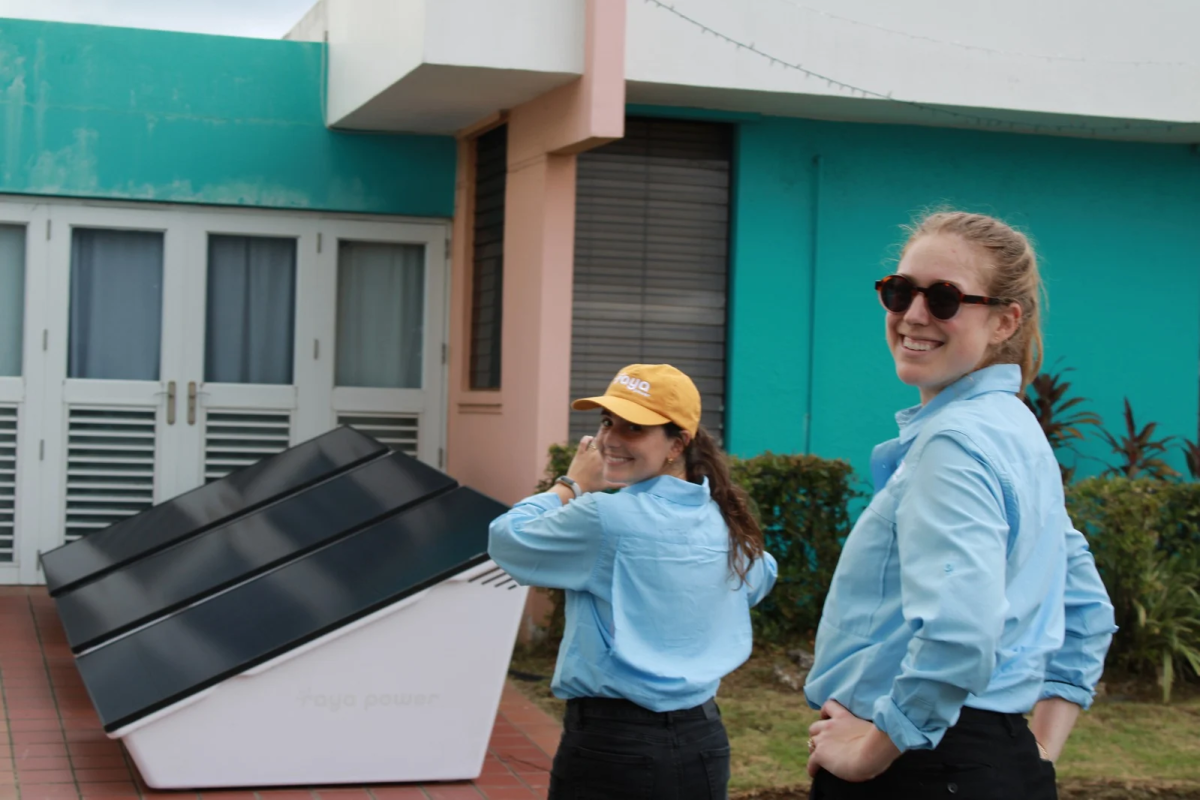
Thus Raya Power was born, a startup founded and led by women that seeks to address a problem that large companies have ignored.
The Problem No One Was Solving
Today, solar energy in the United States is largely designed for a specific segment: people who own homes, have good credit, and the means to invest.
But what about the rest?
“Solar panels are serving 20% of the market,” explains Nicole. “The other 80% —renters, families without property deeds or without access to financing— don’t have real solutions.”
That’s where Raya Power comes in.
A Solution Designed for Latinos and Vulnerable Communities
The company’s proposal is simple yet powerful: affordable solar systems, easy to install, and designed for those who cannot place panels on their roof.
This includes:
Additionally, the model allows families not only to have energy but also to save money.
“A family can save up to $80 a month. That money is used to pay for the system, and over time, it becomes theirs,” she explains.
Beyond Puerto Rico: a Problem Also in the United States
Although the inspiration began in Puerto Rico, Nicole is clear: this crisis is not exclusive to the island.
In states such as California, where Raya Power already operates (Los Angeles and San Francisco), outages due to fires or maintenance also leave thousands of families vulnerable.
And those who suffer the most, once again, are Latino communities.
The Key Drive: Bravo Venture Fellowship
Raya Power’s growth received a major boost when it was selected for the Bravo Venture Fellowship, powered by the Bravo Family Foundation, a philanthropic organization dedicated to empowering the next generation of Puerto Rican leaders and led by investor Orlando Bravo.
This program, which this year expanded for the first time its reach to include founders of Puerto Rican descent in cities like New York and Miami, selects ambitious entrepreneurs with high potential for impact.
As part of the fellowship, participants receive direct investment in their companies and hands-on mentorship for a year, from founders and investors in the foundation’s network and the global firm Thoma Bravo.
For Nicole González, founder of Raya Power —a women-led company seeking to bring affordable solar energy to renters and low-income households—, this backing arrives at a pivotal moment: the company’s commercial launch.
A Clear Vision: Energy as a Right, Not a Privilege
Beyond the technology, Nicole has a clear mission: to change the narrative.
She wants clean energy to stop being a luxury and become something aspirational… yet attainable.
“We want to be like an accessible version of Tesla,” she says. “A high-quality product that people see and say: ‘I want that in my home’.”
And, especially, that Latino communities in the United States see themselves reflected in that solution.