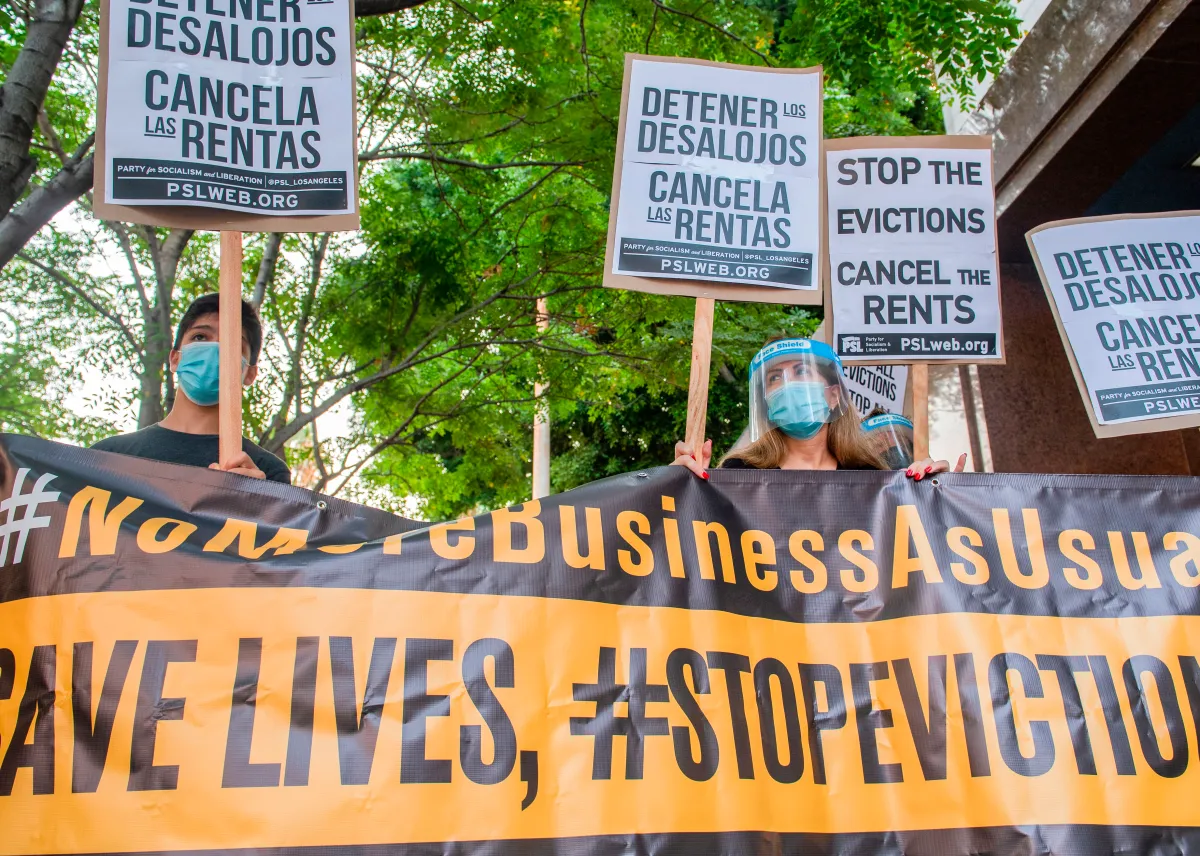
The eviction crisis unleashed by the pandemic hits minority communities far harder than other Americans, and the situation could deteriorate if Congress fails to reach a deal on a new economic relief package, according to the portal The Hill.
A review of more than 8,000 eviction cases by the Center for Public Integrity found that nearly two-thirds of tenants lived in areas where minority representation was above the national average and with an average household income below $42,000 per year. The thousands of evictions stretched from late March to early July, primarily in Florida and Georgia.
The Princeton Eviction Lab, which tracks evictions in 17 cities across the country, has recorded more than 60,000 evictions during the pandemic and more than 1,500 in the past week.
An Aspen Institute study in August projected that between 30 and 40 million Americans could be at risk of eviction if legislation is not changed by December 31, when the CDC eviction moratorium expires.
By the end of September, the National Council of State Housing Agencies published a report saying that nationwide tenants’ debt could reach $34 trillion by year-end.
During most of the pandemic, the federal government issued an eviction moratorium, first under the CARES Act and then under a policy implemented by the CDC. The latter will end by year-end, and experts were debating its effectiveness through the end of 2020.
“The effectiveness (of a moratorium) depends on how comprehensive it is,” said Alieza Durana, who works for the Princeton Eviction Lab. “Normally, a moratorium can affect three different stages of the eviction process. The first refers to the filing of an eviction, the second part relates to the court process itself, and the third to the execution of the eviction process, usually the enforcement by local law enforcement when a sheriff comes to remove a tenant and their belongings.”
“The most effective way to prevent people from being forcefully evicted,” Durana added, “is to ban the three stages or, at least, prevent filings, because even the threat of eviction against a family can negatively affect their physical and mental well-being.”
However, critics have labeled the CDC guidance as vague, noting that it largely places responsibility on tenants to protect themselves from evictions. It also does not provide additional funds for rent relief for tenants or landlords.
What complicates matters is the fact that states often have different tenant laws, meaning the order was interpreted in different ways in courts across the country until the CDC issued a clarifying document that weakened the power of the guidance.
The moratorium is not “intended to prevent landlords from initiating eviction proceedings, so long as the actual eviction of a person covered for nonpayment of rent does not take place during the period of the Order,” the document says.
The moratorium also does not prevent landlords from charging interest or fees on overdue rent.
“It is not a solution. Not even a Band-Aid for the problem,” said Dianne Enríquez, co-director of community dignity campaigns at the Center for Popular Democracy. “It is simply creating the myth that families are protected when they are not actually protected.”