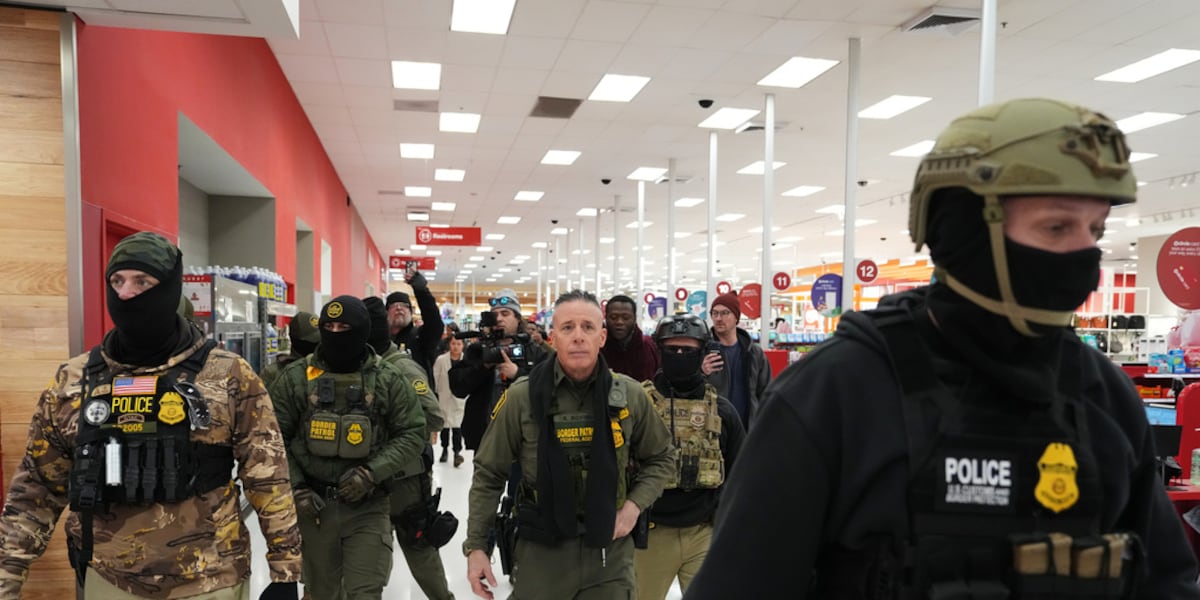
MINNEAPOLIS, Minnesota, USA (AP) — The commander of Border Patrol, Gregory Bovino, is expected to depart Minneapolis on Tuesday, a person familiar with the matter told The Associated Press, as the Trump administration reorganizes leadership of its immigration enforcement operation and trims federal presence after a second fatal shooting by immigration agents.
Trump indicated that he was placing his border czar, Tom Homan, in charge of the mission. Homan will report directly to the White House, after Bovino drew criticism for saying that the man who was shot, Alex Pretti, planned to “massacre” the agents—a description authorities had not corroborated.
The Saturday killing of Pretti, an intensive care unit nurse, at the hands of Border Patrol agents sparked political backlash and raised new questions about how the operation was being conducted.
Bovino’s leadership of highly visible, federally led raids—some of which triggered large demonstrations in Los Angeles, Chicago, Charlotte, and Minneapolis—has drawn fierce criticism from local officials, civil-rights advocates, and Democratic lawmakers.
A person familiar with the matter told AP that Bovino is among the federal agents who will be leaving Minneapolis. The person spoke on condition of anonymity because they were not authorized to discuss specifics of the operation publicly.
Bovino’s departure comes as Donald Trump has adopted a softer tone on the Minnesota crackdown, including praise for discussions with the state’s governor and Minneapolis mayor Jacob Frey.
The mayor said he told Trump in a phone call to curb the surge of immigration agents, and the president agreed that the current approach cannot continue. Frey added that he would continue pushing for others involved in the Metro Surge operation to step back.
Homan will oversee the Immigration and Customs Enforcement (ICE) operations in Minnesota. Frey said he planned to meet with Homan on Tuesday.
Trump speaks with Minnesota governor by phone
Trump and Democratic Governor Tim Walz spoke by phone, and afterward issued remarks that signaled a notable shift from the sharp exchanges they have had in the past. They spoke on the same day a federal judge heard arguments in a lawsuit aimed at halting the current immigration raids in the state.
“In fact, it seems we’re in tune,” the president wrote on social media.
In a statement, Walz said the call was productive and that independent investigations into the homicides are warranted. Trump said his administration would pursue “any and all” criminals detained in Minnesota. Walz added that the state’s Department of Corrections is complying with federal requests regarding people in its custody.
Meanwhile, lawyers for the federal government, the state, and the cities of Minneapolis and St. Paul appeared Monday before District Judge Katherine Menendez, who is weighing whether to grant requests for a temporary halt to the immigration raids.
The judge said the case was a priority. However, in a later order, she asked the federal lawyers to file an additional brief by 6 p.m. on Wednesday. She asked them to address, among other things, the state’s and cities’ assertion that the Metro Surge operation is intended to punish them for sanctuary policies.
The state of Minnesota and the Twin Cities argued that conditions on the streets are so dire that the court should order an end to the federal immigration raids.
“If this doesn’t stop here and now, I don’t think anyone seriously examining this issue can have much faith in how our republic will move forward,” said Brian Carter, Minnesota’s deputy attorney general.
Judge questions government’s motives
The judge questioned the government’s motives for conducting the raids and expressed skepticism about a letter from Attorney General Pam Bondi to Walz, asking the state to grant the federal government access to voter records, to turn over state Medicaid and food assistance records, and to roll back sanctuary policies.
“So, is there no limit to what the executive branch can do under the pretext of enforcing immigration laws?” Menendez asked, noting that the federal requests are the subject of litigation.
Brantley Mayers, a DOJ attorney, indicated the objective is to enforce federal law. Mayers said legal action should not be used to discredit another legal action.
Menendez questioned where the line lies between constitutional rights and the executive branch’s power to enforce immigration law. She also asked whether she was being asked to choose between state and federal policies.
“That starts to feel like I’m deciding which political approach is best,” she said.
At one point, while discussing the possibility of federal agents entering residences without a warrant, the judge expressed reluctance to decide on issues that have not yet been raised in a lawsuit.
Minnesota and the Twin Cities filed suit against the Department of Homeland Security (DHS) earlier this month, five days after a woman, Renee Good, was shot by an ICE agent. Pretti’s death has heightened the urgency of the case.
On Monday night, a federal appeals court refused to lift a temporary stay on a ruling Menendez issued in a separate case on January 16. She had ruled that federal agents in Minnesota cannot stop or gas peaceful protesters who are not obstructing authorities, including bystanders who follow and observe the agents. An eight‑circle Circuit panel said it was unlikely that ruling would stand on appeal.
Homan will report to Trump
News of Bovino’s departure did not deter dozens of demonstrators from gathering outside a hotel they believed Bovino was staying at. They sounded horns, banged pots, and one person played a trombone. Police watched and kept the crowd away from the hotel entrance.
Trump posted on social media Monday that Homan will report directly to him.
White House Press Secretary Karoline Leavitt said Homan would be “the main point of contact in Minneapolis” during the current immigration-enforcement operations.
In court Monday, a government lawyer said there are roughly 2,000 ICE agents in the state, along with at least 1,000 Border Patrol agents.
The lawsuit asks the judge to issue an order reducing the presence of federal immigration agents in Minnesota to pre‑surge levels and to limit the scope of the immigration raids.
The case has implications for other states that have been, or could be, targeted by immigration raids. Attorneys general from 19 states, along with the District of Columbia, filed a brief in support of Minnesota.
In another matter, a different federal judge, Eric Tostrud, considered a Justice Department request to lift an order issued Saturday night prohibiting the Trump administration from “destroying or altering evidence” related to Saturday’s shooting.
State attorney general lawyers told the judge they cannot rely on the federal government to preserve evidence, citing a lack of cooperation after they said they were blocked from accessing the scene.
But federal lawyers argued that the temporary restraining order should be dissolved, because their investigators are already following proper preservation procedures, and they would object to the court’s “micro-management” of what evidence the state may examine while the federal investigation is ongoing.
___
Balsamo reported from Washington. AP journalists Jack Brook in Minneapolis, Giovanna Dell’Orto in St. Paul, Minnesota, and Mike Catalini in Trenton, New Jersey, contributed to this report.