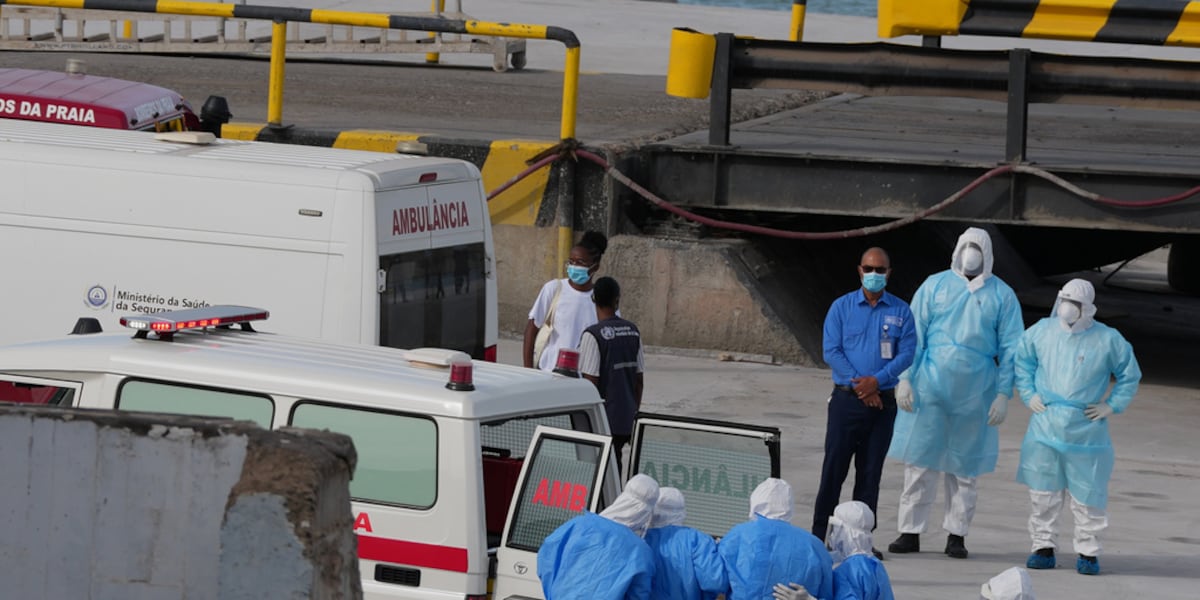
MADRID (AP) — More than two dozen passengers from at least 12 countries disembarked from a cruise ship crippled by a deadly hantavirus outbreak since April, with no contact tracing conducted, and nearly two weeks after a person aboard died, according to the ship operator and Dutch officials on Thursday.
Health authorities on at least four continents are now locating and, in some cases, monitoring the passengers who left the ship on April 24, and attempting to identify others who might have been exposed to them.
Experts say the overall risk to the general population is considered low because hantavirus—typically spread through inhalation of contaminated rodent droppings—does not spread easily from person to person.
The Dutch Health Ministry said on Thursday that a flight attendant on a plane briefly shared with a passenger infected on the cruise in South Africa was showing hantavirus symptoms and would be tested in an isolation room at a hospital in Amsterdam. The cruise passenger, also a Dutch woman, was too ill to fly and was deplaned in Johannesburg, where she died.
If the flight attendant tests positive, she could be the first known case of someone not on the MV Hondius becoming infected.
Three passengers have died so far, and others are ill. Symptoms typically appear one to eight weeks after exposure.
The first hantavirus case on board was confirmed on May 2
According to the cruise line, on Wednesday three people, including the ship’s doctor, were evacuated from the vessel as it neared Cape Verde, a West African island nation, and were transported to specialized hospitals in Europe for treatment.
The company had previously said that the body of a Dutch man who died on April 11 was taken off the ship on the remote South Atlantic island of Saint Helena on April 24, when his wife also disembarked. She flew to South Africa the following day and died there.
The company said Thursday that that same day 29 passengers left the ship on Saint Helena, while the Dutch Foreign Ministry put the figure at around 40. The company had not previously acknowledged that dozens of people had disembarked at that time.
The World Health Organization notes that the first confirmed hantavirus infection in a ship passenger occurred on May 2. It involved a British national evacuated from the ship and transported to South Africa from Ascension Island three days after the stop at Saint Helena. He was tested in South Africa and remains in intensive care there.
The people who left the ship to return to their home countries were from at least 12 different nationalities, Oceanwide Expeditions said. The company also said there were two people whose nationalities were unknown.
On Wednesday it emerged that a man tested positive for hantavirus in Switzerland who had also disembarked at Saint Helena and flew home, though the specifics of his movements are unclear.
On Thursday, Singaporean health authorities said they were monitoring two men who left the ship at Saint Helena and subsequently flew to South Africa and then home. The two men, who arrived in Singapore at different times, were being tested for hantavirus and isolated at the National Centre for Infectious Diseases in the country, officials said.
One of them has a runny nose, while the other shows no symptoms, according to the Singapore Health Sciences Authority.
British health authorities say two people who were aboard the ship but flew home during the voyage were isolated and have no symptoms of illness. The UK Health Security Agency said a “small number” of contacts of the two are also self-isolating but are not showing any symptoms. Contact tracing is ongoing for others.
Saint Helena’s authorities, the remote British overseas territory where passengers disembarked, said they were monitoring a small group of people deemed “high-risk contacts.” Those high-risk contacts were asked to isolate for 45 days, the government said.
South Africa is tracing contacts from an April 25 flight
The ship is now sailing toward the Canary Islands, a Spanish archipelago off Northwest Africa, a three- to four-day journey with more than 140 passengers and crew still aboard.
WHO Director-General Tedros Adhanom Ghebreyesus said on Thursday that he had been in regular contact with the ship’s captain, including this morning.
“He told me morale has significantly improved since the vessel started moving again,” Tedros said.
Authorities in South Africa and Europe are trying to trace the contacts of any passenger who had disembarked earlier. They have focused primarily on the April 25 flight from Saint Helena to Johannesburg, the day after passengers disembarked there.
The Dutch woman who later died in South Africa briefly boarded that flight, officials have said. It is not clear how many other cruise passengers were among the 88 people aboard, but flights from Saint Helena to South Africa are infrequent, typically once a week.
The body of the third fatality, a German woman, remains on the ship after her death on May 2.
Tests have confirmed that at least five people aboard contracted the Andean strain of hantavirus. That strain can trigger a severe, often fatal, respiratory illness called hantavirus pulmonary syndrome.
Argentina’s Health Ministry said hantavirus caused 28 deaths nationwide last year. Nearly a third of those cases ended fatally, compared with a five-year average mortality rate of about 15 percent.
The Andes strain is the only known hantavirus that can spread from person to person.
The ship departed from Argentina, and investigators are focusing on that country as the outbreak’s origin. The Dutch couple, the first passengers to fall ill, traveled there and to other parts of South America, including Chile and Uruguay, before boarding, per the WHO.
Chile’s Health Ministry, on Thursday, ruled out Chile as the source of passenger infections.
“The cases described as primary passed through Chile within a window that does not fit the incubation period, so exposure to the virus would not have occurred in our country,” the ministry said in a statement.
Hantavirus cases are not uncommon in Chile, especially in the Magallanes region (south) and the Atacama region (north), where rodent activity is high. However, the most recent documented human-to-human transmission occurred in 2019.
Since November of last year, an epidemiological alert has been in place to promptly detect and treat hantavirus cases throughout the Chilean territory.