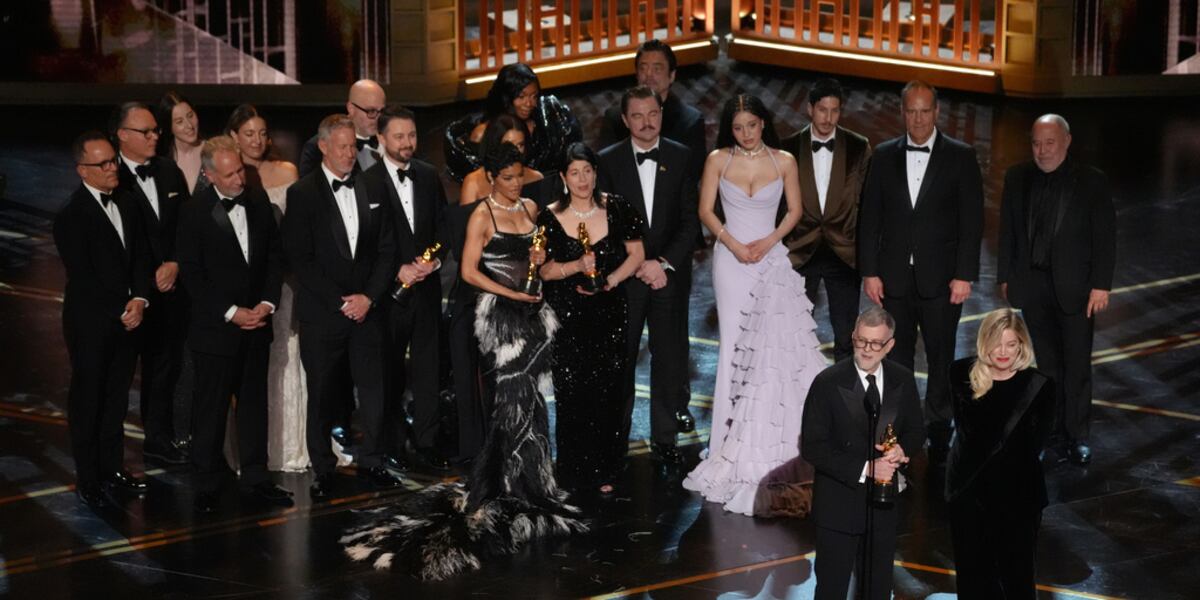
LOS ANGELES (AP) — “One Battle After Another” (“Una batalla tras otra”), by Paul Thomas Anderson, was crowned Best Picture at the 98th Academy Awards, awarding Hollywood’s top honor to a United States multi-generational comic saga about political resilience.
The ceremony took place on Sunday and also saw Michael B. Jordan win Best Actor, while Autumn Durald Arkapaw, the cinematographer for “Sinners,” made history as the first woman to win the Oscar for cinematography. It was a long-awaited coronation for Anderson, a San Fernando Valley native who made his first short at 18 and has been one of the most acclaimed American filmmakers for decades. Before Sunday, Anderson had never won an Oscar.
Yet “One Battle After Another,” the night’s front-runner, claimed six Oscars, including Best Director and Best Adapted Screenplay for Anderson, along with the first Oscar for casting and a Best Supporting Actor win for the absent Sean Penn.
“I wrote this movie for my kids, to apologize for the domestic mess we’re leaving in this world — the one we’re handing them —,” Anderson said upon accepting the screenplay trophy. “But also with the hope that they’ll be the generation who, hopefully, restores some sense and decency.”
“Sinners,” the blues-soaked vampire tale set in the era of segregation from Ryan Coogler, arriving with a record 16 nominations, also scored major—and even historic—wins. Coogler, a dearly beloved filmmaker, won the first Oscar of a flawless career that began alongside Jordan with “Fruitvale Station” (2013). Arkapaw—only the fourth cinematographer ever nominated—took home the prize in a long-awaited triumph for women behind the camera.
“I truly want every woman in the room to stand up. Because I don’t feel I’d be here without you,” Arkapaw said.
And Jordan, one of Hollywood’s most cherished stars, won Best Actor in one of the night’s closest races. The Dolby Theatre rose to its feet for the evening’s loudest standing ovation.
“Hey, Mom, how’s it going?” Jordan asked as he jogged toward the stage.
The Oscar night belonged to Warner Bros., the studio behind “One Battle After Another” and “Sinners,” which tied a record with 11 wins. It was a surprisingly moving triumph for the legendary studio, which weeks earlier agreed to its sale to Paramount Skydance—the media behemoth hastily assembled by David Ellison. The $111 billion deal, awaiting regulatory approval, has Hollywood bracing for further cutbacks.
Yet “Sinners” and “One Battle After Another,” the heavyweights of the season, stood out as Hollywood anomalies: large-budget original stories born from a personal vision. In a year when anxiety about studio consolidation and the rise of artificial intelligence often overshadowed the industry, both films offered Hollywood renewed hope.
Jessie Buckley won Best Actress for her portrayal of Agnes Shakespeare in “Hamnet,” becoming the first Irish actress to take the category, and arrived at Sunday’s Dolby Theatre as the overwhelming frontrunner in an evening when no other acting award seemed secure.
“It’s Mother’s Day in the U.K. I’d like to dedicate this to the beautiful chaos at the heart of a mother,” Buckley said on stage.
From the outset, when host Conan O’Brien sped through the year’s nominees as a nod to Amy Madigan’s character in the horror-thriller “Weapons” (“The Hour of Disappearance”) in a pre-recorded segment, the Sunday ceremony felt peculiar, a touch awkward, and preoccupied with cinema’s evolving place in culture. There was, among other moments, a tie for Best Short Film.
As anticipated, Netflix’s “KPop Demon Hunters,” the year’s most-watched film, won Best Animated Feature, along with Best Original Song for “Golden.” It marked a major victory for Netflix, though the production’s parent company, Sony Pictures, had developed and produced the film but sold it to the streaming giant instead of releasing it theatrically.
On Netflix, “KPop Demon Hunters” became a cultural phenomenon and the platform’s biggest hit, with more than 325 million views and counting.
“This is for Korea and Koreans everywhere,” said co-director Maggie Kang.
Another Netflix release, Guillermo del Toro’s “Frankenstein,” earned three awards for its lavish execution: costume design, makeup and hair styling, and production design.
Amy Madigan won Best Supporting Actress for her role in the thriller “Weapons,” a victory arriving 40 years after the actress, now 75, was first nominated in 1986 for “Twice in a Lifetime.” Letting out a hearty laugh as she stepped on stage, Madigan exclaimed: “This is great!”
Starting for a second time, O’Brien opened the Dolby Theatre with a nod to “chaotic and terrifying times.” Yet he argued that the current geopolitical climate made the Oscars resonate even more as a global unifying force.
“Tonight we salute not just cinema but the ideals of global art, collaboration, patience, resilience, and that rarest of traits: optimism,” O’Brien said. “Let’s celebrate. Not because we think everything is perfectly fine, but because we keep working and hoping for something better.”
Throughout the show, O’Brien targeted several targets, including Timothée Chalamet — who again left without his first Oscar, this time for “Marty Supreme” — for his disdain of opera and ballet. Yet the ceremony itself rarely avoided political overtones, whether referencing shifts under U.S. President Donald Trump or the ongoing war in Iran.
Joachim Trier, whose Norwegian family drama “Sentimental Value” won Best International Feature, cited James Baldwin in his acceptance speech: “All adults are responsible for all children,” he said. “Let’s not vote for politicians who don’t take that seriously.”
Host Jimmy Kimmel, whose late-night show was briefly suspended last year after remarks he made about the death of Charlie Kirk, was among the sharpest voices.
“There are some countries that do not support freedom of expression. I’m not in a position to say which ones,” Kimmel quipped. “Let’s leave it at North Korea and CBS.”
Shortly after, “Mr. Nobody Against Putin,” a film about a Russian primary schoolteacher documenting his students’ indoctrination in support of Russia’s war with Ukraine, won Best Documentary.
“‘Mr. Nobody Against Putin’ is about how you lose your country. And what we found in working with this material is that you lose it through countless small, everyday acts of complicity,” said the co-director.
“We all face a moral choice, but, thankfully, an everyman can be more powerful than you realize,” he added.
The night’s elegy also marked the Oscars. Producers expanded the In Memoriam segment after a year that saw the losses of many Hollywood legends, including Keaton, Robert Duvall, and Redford. Barbra Streisand spoke about Redford, her co-star in “The Way We Were.”
“Bob had real strength,” Streisand said, praising Redford as “an intellectual cowboy” before singing a few bars of “The Way We Were.”
Billy Crystal paid tribute to Rob and Michele Reiner, who were killed at their home in December. Crystal, a longtime friend of Rob Reiner, rose to fame in the memorable 1989 film “When Harry Met Sally…” and the 1987 “Princess Bride.” In his moving remarks, Crystal cited the latter.
“All we can say is: Buddy, how much fun it was storming the castle together,” Crystal said.
Once again, the night’s final award did not go to a streaming release; Apple’s “CODA” remains the only streaming title to have earned that distinction. “Sinners” and “One Battle After Another” were theatrical releases shot on film.
Apple’s main rival this year, the Formula One drama “F1,” which hit theaters in a release run with Warner Bros., won Best Sound. The year’s only box office smash to take home a statue was “Avatar: Fire and Ash” for Visual Effects.
Some of O’Brien’s best jokes targeted the platforms. He teased that Netflix chief Ted Sarandos was in a theater for the first time. He also lamented the lack of Amazon MGM nominations: “Why isn’t the website where I order toilet paper winning more Oscars?”
“It’s an honor to be the last human host of the Academy Awards. Next year is going to be a Waymo in a tuxedo,” O’Brien said.