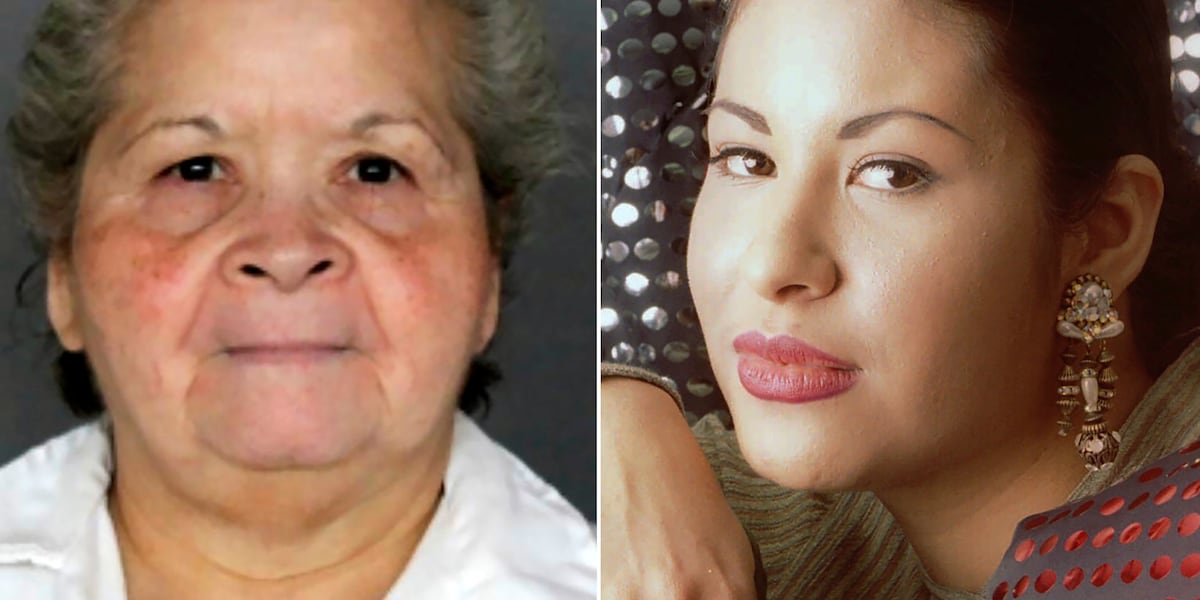
HOUSTON (AP) — Yolanda Saldívar, the woman convicted of murdering Tejano music legend Selena Quintanilla (whose legal name is Selena Quintanilla-Pérez), did not obtain parole and will continue serving a life sentence for fatally shooting the young star at a Texas motel in 1995, the state’s Board of Pardons and Paroles announced on Thursday.
Saldívar, 64, was considered for parole for the first time since the singer’s murder, who fans know simply as Selena.
One of the earliest Mexican-American artists to achieve international fame, Selena broke barriers for women in Latin music. She was 23 and on the verge of pursuing English-language pop stardom when she was killed.
The singer’s family and Chris Pérez, her widower, expressed their gratitude to the Texas Board of Pardons and Paroles.
“While nothing can bring Selena back, this decision reaffirms that justice stands for the beautiful life that was taken from us and from millions of fans around the world too soon,” they said in a statement posted on social media.
In explaining its decision to deny parole, the board said the panel found that Saldívar still represents a threat to public safety. It also noted that the nature of the crime indicated “a conscious disregard for the lives, the safety or the property of others.”
Saldívar, who is serving her sentence in a Gatesville prison, will be eligible to apply for parole again in 2030.
The convict founded Selena’s fan club and served as manager of the singer’s clothing boutiques, Selena Etc., until she was fired in early March 1995 for missing money.
Selena, who spent most of her life in Corpus Christi, was shot in the back with a .38-caliber revolver at a Days Inn motel in that city on March 31, 1995. She managed to run to the motel lobby, where she collapsed, and was pronounced dead at a hospital an hour later.
Motel employees testified that Selena named “Yolanda” in “Room 158” as her attacker.
“I didn’t want to do this. I didn’t want to kill anyone,” a sobbing Saldívar told during a nine-hour standoff with police. She told officers she had bought the .38 revolver to kill herself.
More than 50,000 people lined up to view Selena’s body the day before she was buried at Seaside Memorial Park on April 3, 1995, just 13 days before her 24th birthday.
Saldívar’s trial was moved to Houston because of the publicity surrounding the case. She testified that she had intended to kill herself during the confrontation with Selena, but that the weapon discharged accidentally.
On October 23, 1995, a Houston jury convicted Saldívar of first-degree murder. She was sentenced to life imprisonment with the possibility of parole after 30 years.
While in prison, Saldívar — a former nurse — earned a paralegal certificate and an associate degree in criminal justice and filed several civil rights complaints alleging mistreatment by the state’s prison system, according to court records. She also helped other inmates file petitions.
In court documents filed in 2016, Saldívar said she was being kept in protective custody — meaning she was segregated from other inmates — because prison officials were worried about her safety due to the high-profile nature of her case. She filed several appeals of her conviction, but all were denied.
Selena — “the Queen of Tejano” — rose to fame and won a Grammy during a Tejano music boom in the early 1990s. Her hits include “Bidi Bidi Bom Bom,” “Como la flor,” “Amor Prohibido,” “No Me Queda Más,” and “Tú Solo Tú.”
She opened doors for a new generation of contemporary Latino artists who would go on to enjoy broad popularity with the American public. She often sang in Spanish and spoke English, reflecting a bicultural identity that resonated with listeners.
“Dreaming of You,” her English-language crossover album released a few months after her death, topped the Billboard 200 and featured the hits “I Could Fall in Love” and “Dreaming of You.”
Jennifer Lopez portrayed the singer in the 1997 biopic “Selena.”
The Grammys awarded Selena a posthumous Lifetime Achievement Award in 2021.