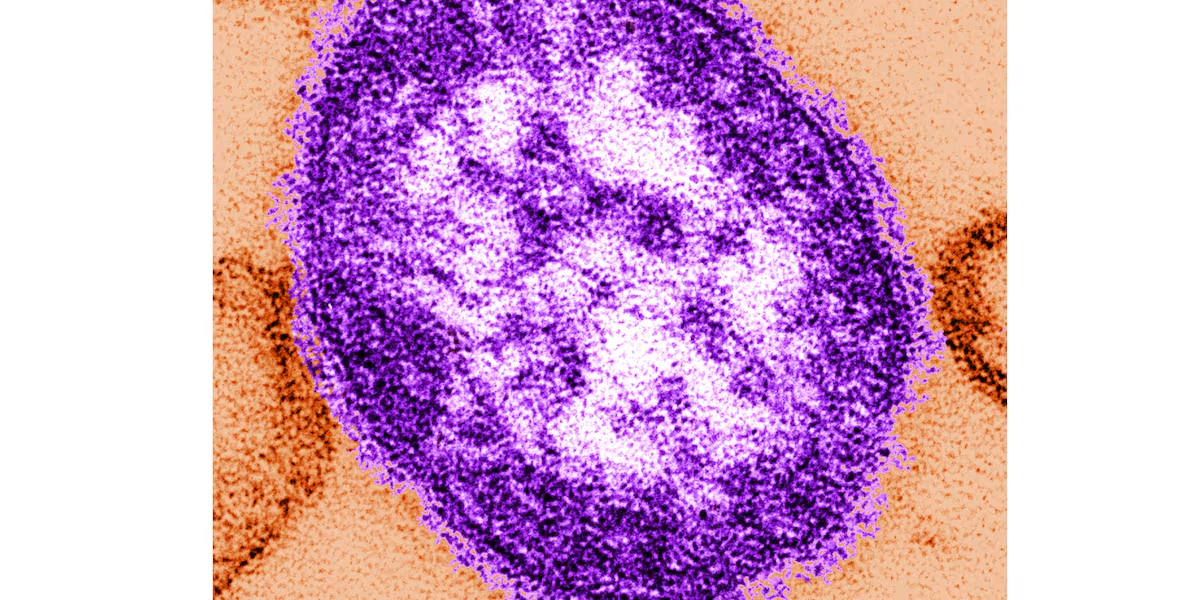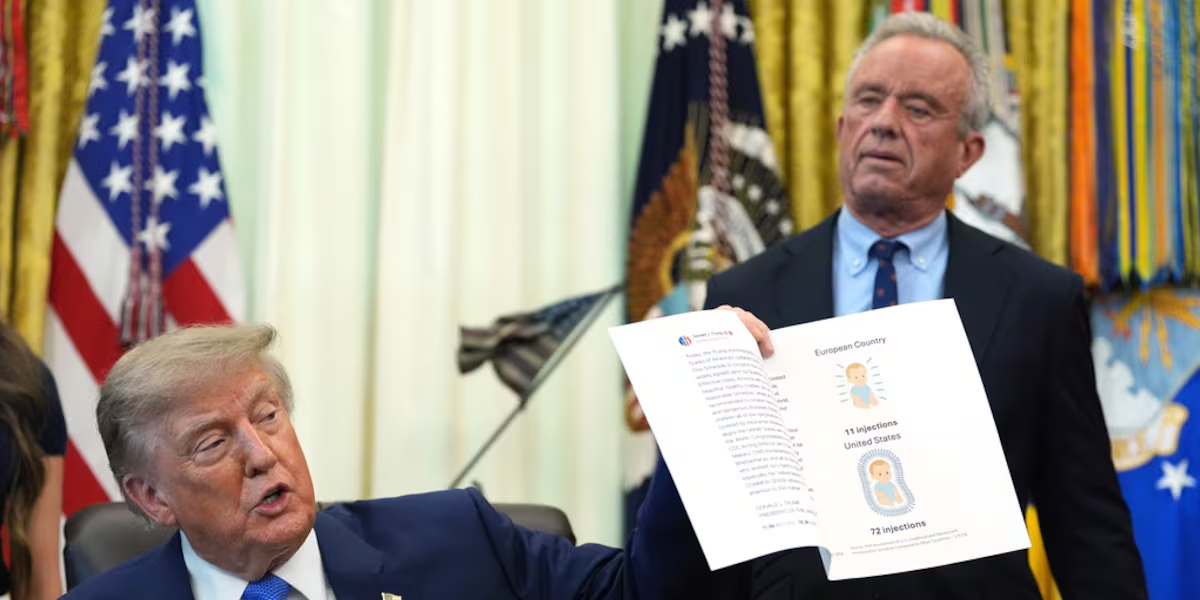
AP – Doctors say that the new vaccine decree from President Donald Trump is poorly targeted and likely to foster fear and confusion among parents at a moment when measles are wreaking havoc, vaccination rates are dropping, and children are returning to school.
“Many families are checking off that back-to-school to-do list, and among those tasks is the medical checkup and making sure their children are up to date on their vaccines,” said Dr. Molly O’Shea, a pediatrician in Michigan. “Questioning the safety or effectiveness of these vaccines right now is truly unfortunate and ill-conceived.”
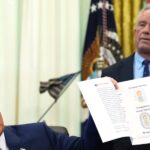
The order, signed on Monday, advocates breaking apart the measles, mumps and rubella (MMR) vaccine into three separate injections, each focused on a single disease, and administering all childhood immunizations at separate visits whenever possible. It also includes several changes to the childhood vaccination schedule that the Trump administration’s health department had already tried to implement, but that a federal judge blocked. The department is led by Robert F. Kennedy Jr., who for years helped lead the anti-vaccine movement.
Trump had repeatedly suggested that the amount or timing of vaccines could influence rising autism rates, even though decades of studies have decisively concluded there is no link. He also strongly implied that the measles, mumps and rubella vaccine could be harmful or even deadly.
Dr. Paul Offit, a vaccine researcher at the Children’s Hospital of Philadelphia and a former government adviser, said that the recommendations from Trump and Kennedy “simply do not rest on science,” and that it is irresponsible to sow doubt about a vaccine that protects against measles when the country is facing its largest outbreak in more than 30 years. “The damage that will be done is… to introduce chaos and confusion into the system, so that people are unsure of what they are supposed to do,” he added.
Trump’s order raises fears
Ahead of signing the executive order, Trump used the word “lethal” when talking about the current MMR vaccine. “Together they could be quite lethal and, separately, they don’t seem lethal at all, but merely very effective,” he said.
Doctors robustly rejected that characterization, noting that the current combined vaccine has undergone rigorous studies and years of safety monitoring—like other childhood vaccines—and has been shown to be very safe. The diseases it prevents pose a far greater risk, they argued.
“The suggestion that separating the vaccines for measles, mumps and rubella has any value is incorrect both scientifically and in terms of immune response. In reality, a stronger immune response is achieved when they are given together. There is no merit in separating them,” said O’Shea.
There are currently no separate vaccines for these diseases in the United States, but Trump’s order directs the health department to present a plan to offer them. Trump spokesperson Kush Desai has said that doing so would give parents more choices about timing and frequency, which would ultimately increase vaccine acceptance.
Doctors lament that Trump revived debunked theories about vaccines and autism. Autism diagnoses have risen for decades, and a recent tally estimated that 1 in 31 children in the United States has an autism spectrum disorder. Scientists say this is partly due to the broadening of definitions with a wider range of traits and symptoms. There is no single cause, they note, and genetic and environmental factors may influence susceptibility.
Dr. Andrew Racine, president of the American Academy of Pediatrics, said that the possible link between childhood vaccines and autism has been studied in dozens of well-designed investigations around the world and that there is no relation “unequivocally.”
The fact that Trump raised the topic, O’Shea said, “is really misdirected and unfair to families.”
Conflicting vaccination schedules increase confusion
Trump’s comments and his order also fuel uncertainty about which vaccines children should receive and when.
In his first year in office, Kennedy sought to overhaul immunization guidelines, removed a 17-member vaccines advisory committee, and installed replacements who drafted restrictive recommendations that a federal judge blocked. Those recommendations called for injections against 11 diseases, with additional vaccines categorized separately for at-risk children or available through “shared decision-making” with a physician.
The American Academy of Pediatrics, for its part, continued to recommend vaccines to protect against 18 diseases in its 2026 immunization schedule. O’Shea said that schedule “has been very well designed, carefully crafted and thought out to provide safety and protection just as the baby’s or young child’s immune system is ready to accept it.”
Doctors noted that insurance coverage should not be a problem. Medicaid and CHIP continue to cover the vaccines recommended before the current Trump administration took office. Through 2027, private health plans generally will do so as well, said Chris Regal of AHIP, the national trade association of health insurers. Doctors say that vaccine hesitancy, and the risks to children, could rise with growing confusion and fear, Racine noted, as pediatricians expect to field more questions from parents.
But many doctors fear that reluctance to vaccinate will keep rising. Federal data show kindergarten vaccination rates in the United States have been falling, and the share of children with exemptions reached a historic high in the 2024-25 school year.
Experts say they are worried families will skip essential vaccines or space out injections, allowing a vaccine-preventable disease to appear between doctor visits.
“Parents deserve clear, evidence-based guidance on how to protect their children, not competing recommendations issued through political processes,” said Michael Osterholm, infectious disease expert at the University of Minnesota. “When families receive conflicting messages, trust in vaccination erodes, and children ultimately pay the price.”