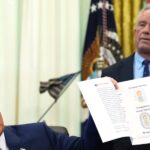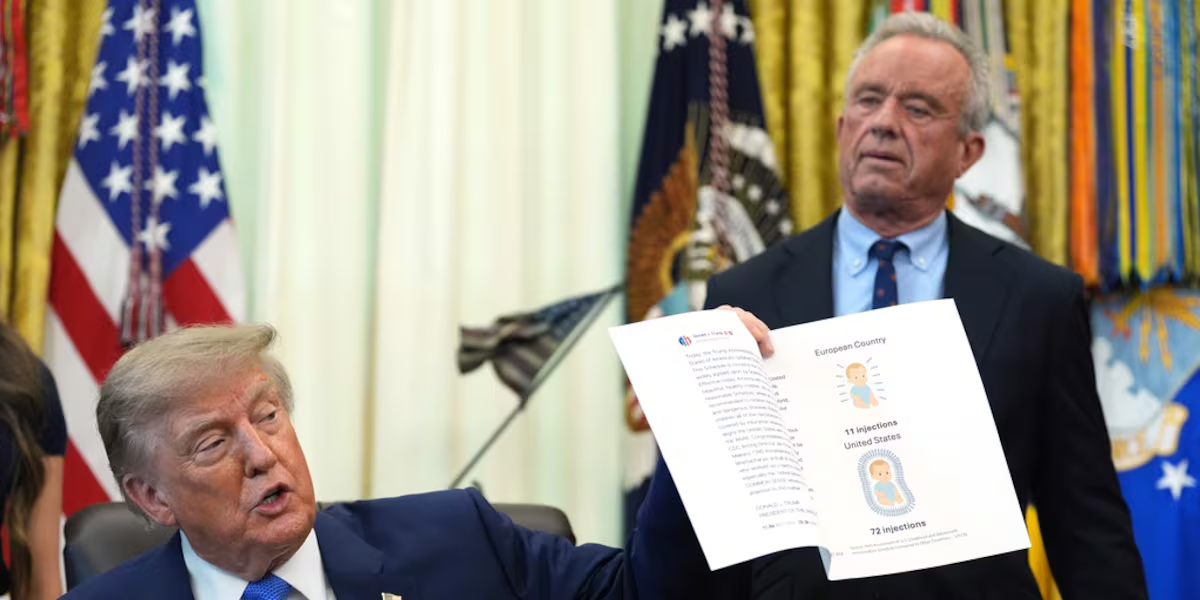
WASHINGTON (AP) — President Donald Trump signed an executive order calling for a refresh of pediatric vaccination recommendations. The measure promotes his long-standing, albeit debunked, belief that pediatric vaccines should be administered during separate visits to the doctor.
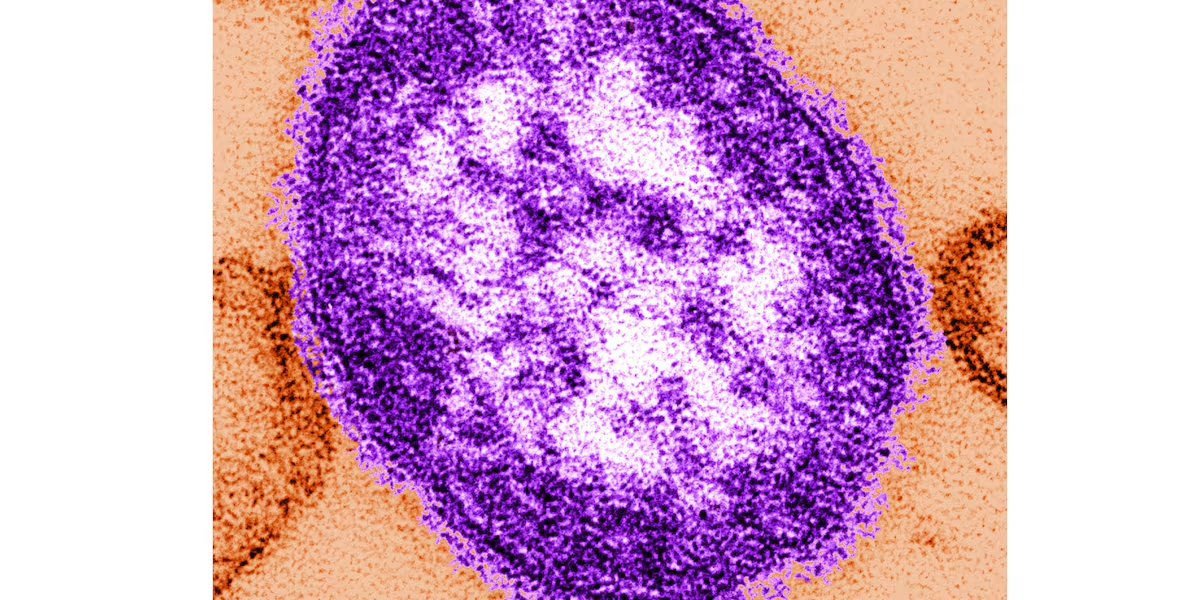
The order recommends splitting the measles, mumps, and rubella (MMR) vaccine into three injections given across separate doctor visits, whenever feasible.
It also directs the federal Department of Health and Human Services to strengthen its vaccine research, which already undergoes rigorous studies, and to present a plan to offer separate vaccines for measles, mumps, and rubella, since there is currently no option to administer these separately in the United States.
The move marks a sharp shift away from the Trump administration’s recent emphasis on less controversial health policies related to healthy eating, drug price negotiations, and anti-fraud actions ahead of the November midterm elections.
Public health experts have expressed concerns that spacing out injections, as Trump proposes, could raise the risk that children contract a vaccine-preventable disease before returning for another visit. Pediatric vaccines—and how and when they are administered in combination—go through rigorous studies, and safety monitoring continues for years as they are used.
Trump described the announcement as a “great victory for the rights of families, religious rights and constitutional rights, and for science of the utmost reliability.”
Regarding the order, Trump hinted on Monday afternoon from the Oval Office that the number of vaccines or the timing of when they are administered might play a role in the rising cases of autism spectrum disorder, even after the medical community and decades of studies have reached a firm conclusion that no such link exists.
The order also includes several changes to the childhood vaccination schedule that the Department of Health and Human Services (HHS) had already tried to implement but were blocked by a federal judge. A White House official, who spoke on condition of anonymity to brief reporters, said Trump was within his rights to offer his own recommendation via an executive order and stressed that the lawsuit blocking the implementation of the HHS-proposed calendar is a separate matter.
Dr. Andrew Racine, president of the American Academy of Pediatrics, said the announcement spreads uncertainty, fear and confusion where “there shouldn’t be any.” He pushed back on the president’s recommendations and argued that the previous guidelines should be kept.
“The science on vaccines and their effectiveness has not changed,” he emphasized. “The distribution of viruses and other pathogens in our environment has not changed. Children in this country have not changed in the last 48 hours.”
Republican Senator Bill Cassidy, who chairs the Senate Health Committee, criticized the executive order on social media, saying that vaccines are safe and do not cause autism.
“I’m a physician. This executive order is wrong,” wrote the Louisiana senator. “The president does not have the knowledge to make these changes.”
Who Is Responsible for Vaccination Policy?
While the order calls for a review of the vaccination recommendations, it is the states—not the federal government—that have the authority to require school vaccination. The order urges states with school-mandated vaccination requirements to consider updating their laws to reflect the calendar favored by the federal government, per a White House fact sheet.
Trump ordered last December that HHS reassess how peer nations handle vaccination recommendations and consider revising U.S. guidelines accordingly. The agency responded by reducing the number of vaccines it recommends for each child, a move that has already been blocked by the courts.
Typically, changes to the federal childhood vaccination recommendations require the approval of the director of the Centers for Disease Control and Prevention (CDC). The new CDC director, Dr. Erica Schwartz, previously oversaw vaccination policies for members of the armed forces while in a leadership role within the United States Coast Guard.
However, public health law expert Lawrence Gostin of Georgetown University noted that the Supreme Court’s interpretation of Trump’s powers could allow him to bypass Schwartz if she does not agree with the new recommendations.
“Clearly, this is the first test for Dr. Erica Schwartz,” Gostin wrote in an email. “The president is putting her in a untenable position.”
When asked during a briefing with reporters why the president was advocating splitting the MMR vaccine into three shots to combat a single disease, the White House official did not present studies to support the decision. He asserted that this has been Trump’s position for some time and that some countries provide single-measles vaccines under certain circumstances.
Kush Desai, a spokesman for Trump, told The Associated Press that the president is “one of countless parents who have raised questions and concerns about the combined MMR vaccine” and said that the plan to develop vaccines for a single disease “would give parents more options about when and how often they are given to their children,” ultimately increasing vaccine uptake.
U.S. studies in infants and toddlers have shown that using combination vaccines, instead of giving one shot for each disease, increases the likelihood that a child will complete the full vaccination schedule by age two.
Other Actions of the Trump Administration on Vaccination
Health Secretary Robert F. Kennedy Jr., who was an anti-vaccine advocate before taking office, set out to reform vaccination guidelines at HHS in the first year of Trump’s presidency. He dismissed all 17 members of an advisory commission and replaced them with officials who issued far more restrictive recommendations, which have already been blocked by a federal judge. He also personally ordered the CDC to drop its stance that vaccines do not cause autism, without providing any evidence to support the change.
Still, Trump has fixated on linking vaccines to autism. He recently stepped up pressure on the health secretary to identify the cause of autism, something Kennedy had pledged to pursue with new research presented last year. Trump publicly pressed the health secretary to provide an update on the status of the investigation during a cabinet meeting last month.
“How is the autism research coming along?” Trump asked.
“We’ll have an answer,” Kennedy replied.
The scientific consensus and decades of research have unequivocally concluded that there is no link between childhood vaccines and autism. Racine reiterated that point on Monday, noting that the topic has been examined in more than 40 well-designed studies across more than seven countries involving more than 5 million children.
“I’m not sure there’s anything studied so thoroughly as this question,” he said. “And the answer is unequivocally no.”
In the Oval Office, Kennedy again said that, in his view, an as-yet-unknown environmental factor is responsible for rising autism diagnoses and noted that his department would release the findings “as soon as they are ready.”
The Monday order comes as children nationwide prepare to return to school and as the nation wrestles with a measles outbreak that, experts warn, could threaten the United States’ measles-elimination status.
Doctors have warned that Trump’s vaccine misinformation could fuel vaccine hesitancy. Federal data show kindergarten vaccination rates in the United States have been slipping, and the share of children with exemptions reached a historic high during the 2024-25 school year.