New York (AP) — In a matter of months, watching immigration agents stop people—often amid anger and public outcry—has become a common sight in the United States.
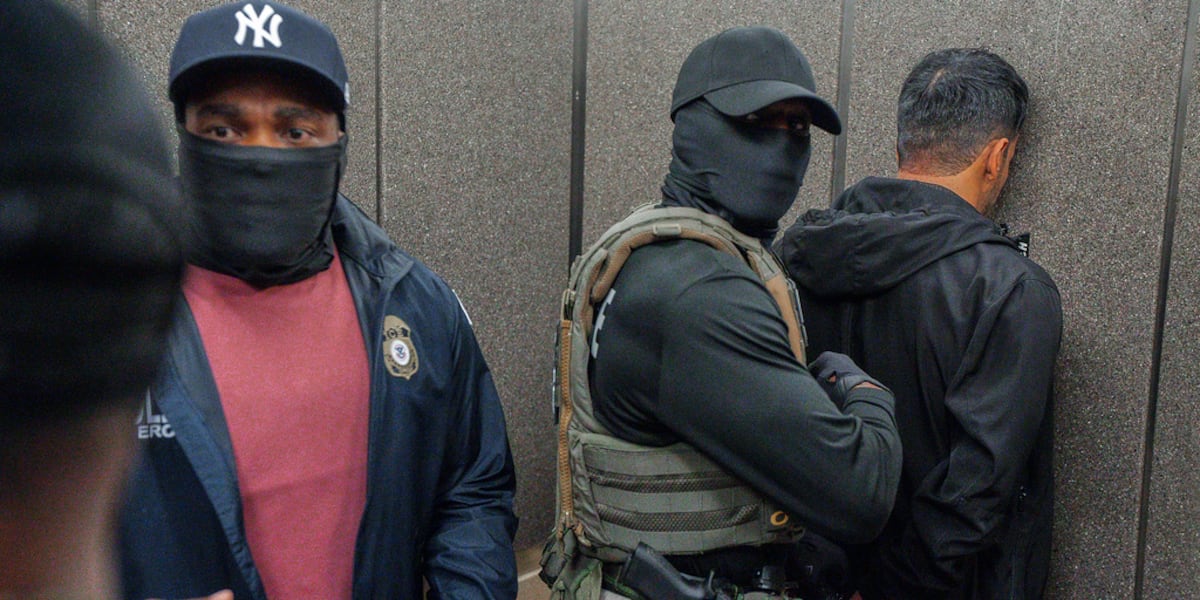
But something has vanished from the process: the agents’ faces, hidden behind hats, sunglasses, high collars, or balaclavas, leaving them nearly unrecognizable.
By the middle of the year, the masked faces of agents during the wave of immigration raids ordered by President Donald Trump have become one of the most powerful and controversial images of 2025.
The rise in immigration restrictions was already a contentious issue among those who oppose the federal government’s actions and those who support them. The masked- agents image implementing those policies is creating an entirely new level of conflict, unmatched in American history.
U.S. government officials have consistently defended the practice, insisting that immigration agents have faced growing and sullen harassment in public and online as they carry out their work in service of Trump’s promises to carry out mass deportations, so concealing their identities is for their safety and that of their families—to prevent things like death threats and doxxing—publishing personal information about someone online without consent.
“I’m sorry if people are offended by mask use, but I’m not going to allow my officers and agents to go out there and put their lives in danger, their families at risk, because people don’t like what immigration enforcement does,” said Todd Lyons, the acting director of the Immigration and Customs Enforcement (ICE).
There is resistance, as expected
Democrats and others, including several state attorneys general, have pushed back against the move, arguing that masked faces instill fear in the public and that the practice should end.
In a letter to Lyons last week, a group of Democratic senators said that the tightening of immigration restrictions in workplaces, restaurants, and other sites was already causing consternation and that the increasingly common image of masked agents “represents a clear attempt to heighten that fear and chaos, and to prevent those agents from being held to account for their actions.”
In American culture, covering one’s face has often been linked to misbehavior. Like the bandits wearing bandanas in Western films, or robbers donning ski masks before a bank heist. Even comic-book superheroes who conceal their identities have, in recent years, been drawn into plots that refer to them derisively as “masked” and insist that their decision to hide their identities while delivering justice is transgressive.
Moreover, the presence of police or paramilitary forces with their faces covered has been viewed by Americans as contrary to the promises of democracy and justice for all—and to the common-law principle of facing one’s accusers.
Generally, wearing a mask suffered another blow in American life during the COVID-19 pandemic, when many Trump supporters mocked the notion that masks would isolate people from the deadly virus and disparaged those who wore them. More recently, Trump has spoken out against people who cover their faces, at least among protesters. Last month he posted on social media that protesters who wear masks should be arrested.
Given all that cultural context, it’s even more problematic that those enforcing the laws are the ones masking their faces, said Tobias Winright, professor of moral theology at Saint Patrick’s Pontifical University in Maynooth, Ireland. He has studied U.S. policing practices and often writes about police ethics.
“If what you’re doing is right and transparent,” he noted, “then why hide your identity?”
Power gives different meanings to different symbols
For those wondering why it’s different for law enforcement to wear masks when protesters and non-police personnel do as well, it’s because symbols take on different meanings depending on who wields power and their position, said Alison Kinney, author of Hood, a book about hoodies and the many ways people have used them.
“ICE agents are state actors, and not only have they been granted power, but protections to carry out their work,” she said. “But that work is also a public service. It’s also supposed to be accountable and transparent to the public.”
“And therefore, they bear a greater obligation of transparency and accountability and of identifying themselves so we can hold them to account for the justice or injustice of their actions,” she explained.
This isn’t the first time concerns have arisen about how to hold law enforcement accountable to society. Activist groups have pressed for body cameras and for police to display names and badge numbers. But there hasn’t been much discussion about masking among police, since there is no history of it being done officially and widely in the United States outside of SWAT or undercover operations, Winright noted.
The most prominent example in American history of masking to conceal identity is also the most grim: the racially motivated attacks carried out by Ku Klux Klan members.
Masks, of course, served to keep the wearers’ identities secret, said Elaine Frantz, history professor at Kent State University and author of Ku-Klux: The Birth of the Klan during Reconstruction. But they also facilitated the wearer’s ability to commit violent acts against others, she added.
“The issue with masks is that they function as a shield against disruption,” Frantz said. “The more distance you have from the person you’re attacking, the easier it is to dehumanize that person.”
Winright said he hopes masking by law enforcement does not become normalized. There has already been at least one expansion to local police. In Nassau County, on Long Island just outside New York City, County Executive Bruce Blakeman signed last week an executive order allowing police officers to wear masks during certain operations, including collaboration with immigration agents.
However, Winright worries the movement could strain police–community relations even further, placing officers in greater danger.
“Wearing a mask seems to heighten fear and erode trust, and police—from the federal level down to local—need trust, transparency, and positive community relationships,” he said.
He added: “The harms, the risks, are greater when masks are worn—not only for each officer, but for the profession as a whole, as well as for American society. It will only exacerbate the polarization between us and them, the lack of trust, and that’s probably the last thing we need right now.”