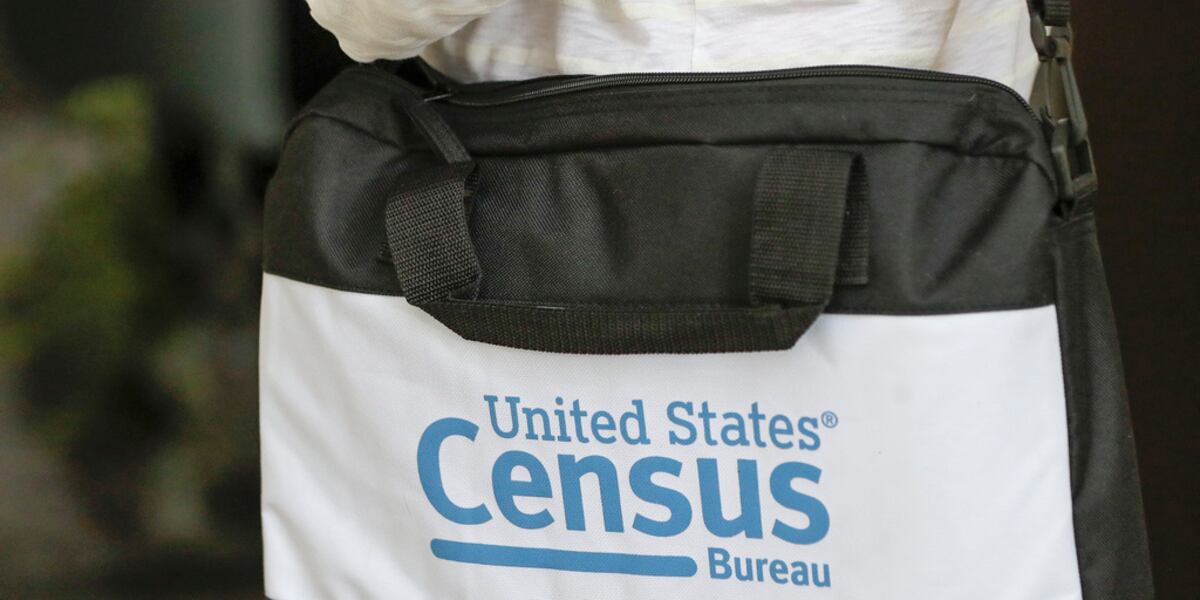
WASHINGTON (AP) — President Donald Trump ordered the Department of Commerce to change how the Census Bureau collects data, aiming to exclude unauthorized immigrants who are in the United States, he said Thursday.
The census data collections will be based on “facts and figures today and, most importantly, use the results and information obtained from the 2024 Presidential Election,” the Republican president said on Truth Social, an indication that he could try to fold his policy into the survey work that measures everything from child poverty to business operations.
Trump emphasized that, as part of the changes, people who are “illegally in our country” will be excluded from census counts.
His post on Truth Social fits a broader pattern in which he seeks to reshape, to his liking, the basic measurements of how American society functions, a process that spans from the monthly job figures to how congressional districts are drawn ahead of the 2026 midterm elections. But there could be legal challenges if he tried to reshape the census, which also guides the distribution of $2.8 trillion in federal funds to states for roads, healthcare and other programs.
In a decision taken in 2019, the Supreme Court prevented Trump from adding a citizenship question to the 2020 census. The 14th Amendment says that “the total number of people in each state” must be counted to obtain the figure used for the distribution, the process of allocating seats in Congress and the Electoral College votes among the states based on population.
The last time the census included a citizenship question was in 1950, and the Census Bureau’s own experts projected that millions of Hispanics and immigrants would not be counted if everyone were asked whether they are U.S. citizens.
The changes to the census could also influence Trump’s efforts to urge several Republican-led states, such as Texas, to redraw their parliamentary maps ahead of schedule, in ways that would benefit candidates from his party.
Redistricting typically occurs once every ten years after the census, as states adjust the boundaries of districts based on population changes, often gaining or losing seats in the process.
Despite Texas redrawing its maps only a few years ago, Trump is pressing the state’s Republicans to repeat the process, saying they have “the right” to five additional Republican seats. Texas Republicans cite population growth as justification for redrawing the legislative map.
Trump’s team is also involved in similar discussions about district redistribution in other Republican-controlled states, such as Missouri and Indiana.
Last Friday, the president fired Erika McEntarfer, head of the Bureau of Labor Statistics, after standard revisions to the monthly jobs report showed that employers added 258,000 fewer jobs than had been previously reported in May and June. The revisions suggest that hiring has weakened sharply during Trump’s term, undercutting his claims of an economic boom.
The White House insists that the problem was the size of the revisions and that it wants precise numbers.
The post about the census raises the question of whether he would undertake a mid-decade count, or simply adjust the standards for 2030, or alter how estimates are produced between censuses. It is not clear what changes he would implement.
Logistically, conducting a mid-decade census in so short a period would be nearly impossible, said Jeffrey Wice, a professor at New York Law School. Any change to conducting a national census, which is the federal government’s largest non-military undertaking, would also require the approval of Congress, which has oversight responsibilities, and there would likely be a fierce fight, he said.
“This is not something you can do overnight,” said Wice, an expert in census and redistricting. “Bringing all the pieces together would be an enormous, if not impossible, challenge.”