MINNEAPOLIS (AP) — President Donald Trump threatened on Thursday to invoke the Insurrection Act, a move that would allow him to deploy troops as protests against immigration raids in Minneapolis continued.
Trump made the threat after a federal agent shot a man in the leg in Minneapolis on Wednesday, following an attack with a shovel and a broom handle. The incident further amplified the fear and anger gripping the city a week after an Immigration and Customs Enforcement (ICE) agent shot and killed a woman in the head.
Trump has repeatedly threatened to invoke the federal law, which is rarely used, to deploy the military or call up the National Guard for domestic-law enforcement, despite objections from state governors.
“If Minnesota’s corrupt politicians do not obey the law and prevent professional agitators and insurrectionists from attacking ICE Patriots, who are simply trying to do their jobs, I will invoke the INSURRECTION ACT, as many Presidents have done before me, and swiftly end the charade taking place in that once-great state,” Trump wrote in a post on social media.
An federal agent shot a man in the leg in Minneapolis after he was attacked with a shovel and a broom handle, heightening fear and outrage that has spread through the city a week after an ICE agent killed a woman by firing a shot to the head.
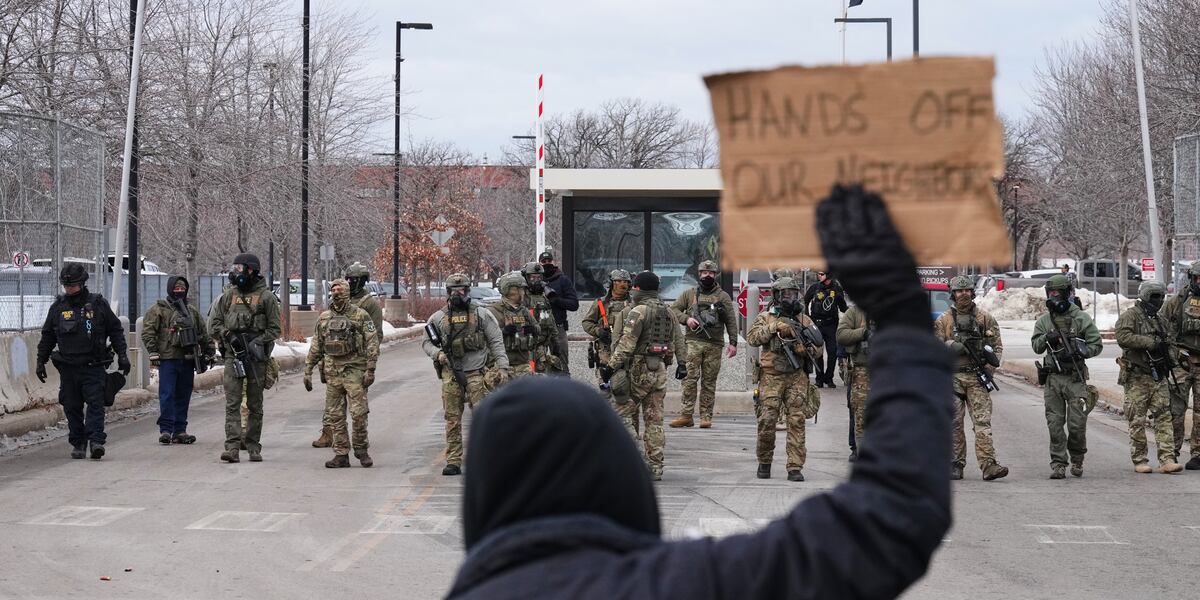
The smoke filled the street Wednesday night near the scene of the latest shooting as federal agents wearing gas masks and helmets fired tear gas at a small crowd, while protesters threw rocks and pyrotechnic devices. Minneapolis Police Chief Brian O’Hara told reporters that the crowd was an illegal assembly and that “people must go.”
Later, things began to quiet down at the scene, and by Thursday morning there were fewer protesters and fewer law enforcement officers present.
These protest scenes have become common on the streets of Minneapolis since a federal agent fatally shot Renee Good on January 7 amid a sweeping immigration raid operation that has sent thousands of agents to the Twin Cities. Agents have dragged people from cars and homes and have been confronted by angry residents demanding that the agents pack their bags and leave.
Minneapolis Mayor Jacob Frey described the situation as “unsustainable.”
“This is an untenable situation our city is in right now, and at the same time we’re trying to move forward in a way that keeps people safe, protects our neighbors, and maintains order,” he said.
Frey described a federal force that is five times larger than the city’s police department of about 600 officers and that has “invaded” the city, frightening and enraging residents, some of whom want police to “fight ICE agents.” At the same time, the police force remains responsible for its daily duties of maintaining public safety.
The Department of Homeland Security says it has made more than 2,000 arrests in the state since early December and pledges not to back down.
In a statement outlining the events that led to Wednesday’s shooting, DHS said federal agents detained a person from Venezuela who was in the United States without lawful residence. The person drove away in a vehicle, collided with a parked car, then fled on foot, the department said.
After agents reached the person, two more people arrived from a nearby apartment, and the three began attacking the agent, the department said.
“Fearing for his life and safety as he was ambushed by three individuals, the agent fired a defensive shot to defend his life,” the department said.
The two people who left the apartment were detained, it said.
O’Hara said the man who was shot was in the hospital with injuries not believed to be life-threatening.
The shooting occurred about 4.5 miles (7.2 kilometers) north of where Good was killed. O’Hara’s account largely matched DHS’s account.
Earlier Wednesday, a judge gave Trump’s administration time to respond to a request to pause its immigration crackdown in Minnesota, as the Pentagon sought military lawyers to join what has become a chaotic policing operation.
“What we need most right now is a pause. Temperatures have to cool,” said Brian Carter, an aide to the state attorney general, during the first hearing on a suit brought by Minnesota and the cities of Minneapolis and St. Paul.
Local leaders say the administration is trampling free speech and other constitutional rights. U.S. District Judge Katherine Menendez gave the Department of Justice until Monday to respond to the injunction bid.
The DOJ lawyer, Andrew Warden, suggested that the approach laid out by Menendez was appropriate.
The judge also oversees a separate suit challenging the tactics used by ICE and other federal agents when they encounter protesters and bystanders. A decision could come this week.
In a televised address before Wednesday’s shooting, Governor Tim Walz said there was a chaotic situation in Minnesota, and that what is happening in the state “is hard to believe.”
“Let me be very, very clear: this stopped being an immigration-enforcement issue a long time ago,” he said. “Instead, it is an organized campaign of brutality against the people of Minnesota by our own federal government.”
CNN, citing an email circulating within the military, said Defense Secretary Pete Hegseth is asking the service branches to identify 40 lawyers, known as General Counsel or JAG officers, and 25 of them will serve as special assistants to federal prosecutors in Minneapolis.
Pentagon spokesman Kingsley Wilson seemed to confirm CNN’s report by posting on X that the military “is proud to support” the Department of Justice.
The Pentagon did not immediately respond to AP’s requests for comment seeking more details.
It marks another step by the Trump administration to send both military and civilian lawyers to areas where federal immigration enforcement operations are underway. The Pentagon last week sent 20 lawyers to Memphis, according to federal prosecutor D. Michael Dunavant.
Mark Nevitt, an associate professor at Emory University School of Law and a former JAG, said there is concern that these assignments could pull lawyers away from the military justice system.
“There aren’t many JAGs, but there are more than a million service members, and everyone needs legal support,” he said.
Jonathan Ross, the Immigration and Customs Enforcement agent who killed Good, suffered internal bleeding in the torso during the encounter, a Homeland Security official told The Associated Press. The official spoke on the condition of anonymity to discuss Ross’s medical condition. The official did not provide details about the severity of the injuries, how the wound occurred, when it was diagnosed, or how he was treated.
There are many causes of internal bleeding, ranging from bruising to life-threatening blood loss. A video of the scene showed Ross and other agents walking away from the scene with Good without any obvious signs of immediate difficulty.
Good was killed after three ICE agents surrounded her SUV on a snowy street a few blocks from her home.
A bystander video shows an agent ordering Good to open the door and grabbing the handle. As the vehicle begins to move forward, Ross—standing in front—raises his weapon and fires at least three times at close range. He steps back as the SUV advances and then twists away.
Homeland Security Secretary Kristi Noem has said that Ross was struck by the vehicle and that Good was using her SUV as a weapon—a self-defense claim that Minnesota officials have harshly criticized.
Ross’s attorney, Chris Madel, declined to comment on any injuries.
Meanwhile, Good’s family has hired the law firm Romanucci & Blandin, which represented George Floyd’s relatives in a $27 million settlement with Minneapolis. Floyd, a Black man, died after a White police officer pressed his knee into his neck on a city street in May 2020.
The firm said it would conduct its own investigation and publicly share whatever it uncovers.